
The Maze
Dynamic problem-solving initiative that can be linked powerfully to real life
At A Glance
A group attempts to navigate the correct path across a series of spots on the ground.
 What You Need
- Bunch of rubber spots / carpet tiles / chalk circles
- Pen & paper
What To Do
This is an ideal problem-solving exercise when you don’t have a lot of room to use.
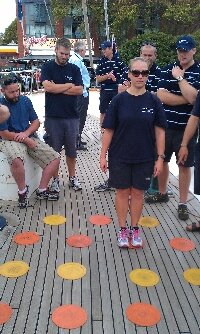
In advance, lay a series of rubber gym spots /carpet tiles or simply draw chalk circles on the floor, arranged in rows and columns (see photograph). There’s no magic number, but the more spots, the more difficult the task will be.
Start your group at one end of the spots, and explain that you would like the group to navigate their way through the maze – one step at a time – to identify the secret pathway. The correct path starts with one of the spots in the top row (closest to the group), and will finish with one of the spots which form the final row. How the path travels between those two points is a secret.
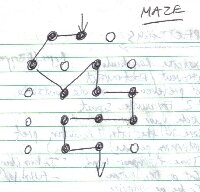
As with electricity, suggest that the secret pathway will follow the path of least resistance, so it will not run in a straight line, and may turn in any direction, but it will never cross itself, nor use any spot twice (see sample below). Also explain that once identified, the path will not change.
Instruct your group that only one person is entitled to enter the area of the spots at any point in time. To this end, the group may choose to task several people to enter the area to navigate the path, but only ever one person at a time. Explain that every time a spot is stepped on (with both feet), you will either give the thumbs up (yes, part of the path) or thumbs down (no, not the correct path). Tally the number of “errors,” challenging the group to navigate the path with as few errors as possible.
This is the basic set-up. To add extra spice, add one or more of the variations described below.
Note, like many problem-solving activities, this activity and its execution are wonderfully applicable to many a metaphor. For example, the maze represents a journey (or the life of a group), because it has a start and an end and many unknowns in between, and to be successful the whole group must work together, etc.
Variations
-
 Each time an error is made (stepped on wrong spot, or perhaps in wrong sequence), require the stepper to retrace their correct steps back out of the maze returning to the start.
- Establish a maximum number of “errors” the group can incur to be “successful.” Based on the maze I often use (illustrated at right), most groups are able to be “successful” in 30 or less errors.
- Ask the group to complete the task silently, ie no verbal communication once the spotted area is entered for the first time. This may mean that they group can talk during their designated planning time.
- For groups still developing their social skills, use less spots or a greater number of allowable errors.
Do you have other ideas about this exercise? If so, let me and the world know by clicking here…
Up The Challenge
Hi folks,
This is not a full write-up, but I wanted to quickly share a great idea I came across which was posted on a list-server I’m subscribed to…
Many people are familiar with The Great Egg Drop problem-solving activity, but it’s been around for a while, and so the question was asked – What else is out there?
 Try this – inflate a bunch of balloons using helium. Distribute one (or more) to each person or small group. The task is for each person/group to attach whatever they choose (or you could limit the resources) to the base of the balloon(s) with the objective of becoming the last balloon to reach the ceiling/roof.
The only condition is that to “win” a balloon must eventually reach the ceiling/roof.
This exercise kind of reminds me of the plot from the film ‘Up.‘
Awesome! Try it out, and tell me what you think by adding a comment…
Have FUNN 
Metronome
A fun, new initiative that’s very addictive
At A Glance
Individuals navigate through a field of spots and MUST be on a spot when the beat sounds.
What You Need
- One polyspot per person plus half again as many spots (if you have 20 people, you’ll need 30 spots)
- One hula-hoop
- Stop-watch
What To Do
This is pretty new to me, so I’m still having fun working with it.
In advance, spread a set of polyspots (rubber spots about 30cm diameter) randomly throughout an area, with approx 3 or 4 large steps between them. Lay the hoop in the middle of the playing area.
Describe to your group what a metronome is, you know, that strange ticking device that sounds a beat over and over without stopping, often used to keep time in music. Explain that the challenge is for everyone in the group to either be on a spot or in the hoop at the sound of every beat (unless you can find a real metronome, clapping of your hands, beating a drum, etc).
Start by asking every student to stand on a spot. There can only be one person on a spot or inside the hoop at a time, and movement between spots can only be done between the beats of the metronome.
If anyone is caught off a spot as the metronome sounds, or more than one person is discovered on a spot (or hoop), the action stops, and the time is recorded. Between rounds, allow your group a few minutes to plan their strategy. The aim is to record the longest time.
Variations
- As above, but explain that the metronome will beat at an ever-so-slightly faster pace with each round.
- As above, but designate the hoop as a resting point, where up to three people can stand for up to five beats.
- Start with the hoop at the farthest end of the playing area (which has spots spread throughout). Your group starts at opposite end, and aims to move everyone through the hoop as quickly as possible – but only by moving people between beats, one person on a spot at a time, etc.
Have FUNN!
If you can think of a cool variation to this activity, please add a comment…
Change Up
A simple line-up initiative using a deck of cards.
At A Glance
A group attempts to form a line as quickly as possible according to the numerical sequence of the playing card each person is holding.
What You Need
- Regular deck of cards
- Stop-watch
- 15 – 30 minutes
What To Do
This initiative has become one of my latest favourites because it’s so simple, and always provides plenty of opportunity for discussion at the end.
 Start by randomly distributing one card (face-down) from a regular deck of cards to each person in the group. Ask people not to look at their card, or show it to another person.
Explain that you will issue two loud commands for each of several rounds – GO, and STOP.
On “GO,” you invite everyone to turn their card over (for the first time) and then as quickly as possible, form one straight line according to the numerical order of the cards, aces high. That is, 2, 3, 4, 5, 6, 7, 8, 9, 10, Jack, Queen, King, Ace – regardless of suits, so if three people were holding 7′s, it would not matter in what order they stood provided they all lined up between the 6′s and 8′s. Using a stop-watch, your job is to time how long this process takes.
Between each round, the group is entitled to pool their creative resources and try to think of ways to improve their time. When the group is prepared to be timed again, explain that you want all cards turned face down again, and then with a simple one-for-one swap, invite everyone to mingle and make as many trades as possible… until you say “STOP.” At this point, without turning the cards over, invite the group to do whatever it needs to do to be ready for the next command… “GO” which means the clock starts ticking again.
Hint, be sure to focus the group’s efforts on solving the “timing” problem, and not the method in which the cards are “randomly” distributed between each round.
Good solutions not only feature good problem-solving and decision-making skills, but also an emphasis on systems and creativity.
Variations
- Same as above, yet explain the criterion of success is the alphabetical order of the cards (not numerical). You will literally hear the cogs grinding in people’s heads as they grapple with this change. So, now, suits do matter (Clubs, Diamonds, Hearts, Spades – in that order) when two or more of the same card value occur. For example, the 3′s will now necessarly sit between the 6′s and the 2′s (… six, three, two …)
- Use a bunch of coins, and distribute as above, with the goal of forming a line according to the order of their year of manufacture, eg 1978, 1982, 1983, 1991…
If you know of a cool variation to this exercise, please add a comment…
About Now
A simple sixty second guessing game.
At A Glance
Individuals standing as a part of their group will sit down when they estimate sixty seconds has elapsed since the starting command of “now.”
What You Need
- A comfortable, open space for people to sit on the ground
- A time piece with a second hand
- 5 – 10 minutes
What To Do
Bunch your group together in front of you with sufficient room for each person to sit on the ground, but don’t sit down yet! With a time piece at the ready, instruct your group to sit down when they believe exactly 60 seconds has elapsed. Note, there is no talking permitted during the exercise, so that individuals assume full responsibility for when they believe the sixty seconds as expired.
Obviously, it will be necessary for people to not look at their watches as they perform this task, ie if the temptation is too great, ask that all watches be removed. Also, you are well advised to check that the area you are playing in does not have a clock on the wall (but that’s another story).
The time starts ticking when you call out “NOW”, and off they go. It’s extraordinary how quick some people believe one minute will pass, or how long. Purely out of interest, note the person(s) who sits at or closest to the sixty-second mark.
Observe how group pressure plays a part in people’s decision-making processes. It will look like corn popping in reverse – a few early sits, then a few more, then a flurry of them for an extended period, and then some late ones. And then of course, there’s always a few tough, residual corns that just refuse to pop (and get burned)!
Variations
- Same deal, but this time the group can communicate with each other all they like, before and during the exercise, with the objective of having everyone sit at the same time. Emphasis is on seeking consensus, as well as achieving a group-sit as close to one minute as possible.
- Stand your group in a line at the edge of a wide space, and ask them to walk to the other side at a pace which will have them cross a designated line at exactly sixty-seconds.
If you know of a cool variation to this exercise, please add a comment…
TP Shuffle On A Rope
Indoor (and outdoor) variation of a classic initiative.
At A Glance
A group standing on a straight line of rope attempts to re-order their positions, ensuring that all movements are made with at least one foot on the rope at all times.
What You Need
- Long piece of rope (say 10m for 25 people)
What To Do
The original TP Shuffle is a wonderful group initiative, but as it required a long 5 to 8 metre pole (TP = telephone pole) laying on its side, it was not always readily accessible. Until now…
Lay a long rope in a straight line on the floor (or relatively even ground) and ask your group to stand directly onto it with both feet.
Next, explain that you would like them to now re-arrange their current positions according to a particular sequence, for example, the month and date of their birth. So, at one end of the rope it is possible that someone may be standing with a birth date of 1 January, and next to them, 2nd of January, and so on, through the days and months to 31 December at the opposite end of the rope.
However, here’s the kicker – all movements must be made with at least one foot always touching the rope. If at any time, one or more people involved in a move should discover that both of their feet are not touching the rope, they will incur a penalty. Penalties can also be incurred if any other part of the body (such as a hand or butt) should touch the ground – often because they were used to break a fall.
Typically, penalties vary from simply counting the number of infractions, to requiring the offender to move to the end of the rope opposite to the direction they were travelling. For example, if a person with a birth date of September should come off the rope, they must start over from the January end of the rope. Yeah, tough, I know!
While clearly the task is not performed while balancing on a telephone pole, this variation does offer many of the benefits of the original, including the development of creativity, support and communication skills.
Variations
- Vary the sequence criteria, such as last two digits of their mobile phone number, street number, height, shoe size, length of hair, etc.
- Complete the task with several members of the group blindfolded.
If you know of a cool variation to this exercise, please add a comment…
Madagascar Rescue
A creative group initiative that combines many problems into one.
At A Glance
A group standing on a large tarp must first manage to flip the tarp upside-down without touching the ground, and then rescue a series of objects strewn around them.
What You Need
- A large tarp (preferably non-rip material)
- One “stepping stone” per person
- Bunch of objects, such as soft toy animals
What To Do
This initiative is a classic example of how much fun it can be to combine two or more individual problem-solving activities into one. In this case, I am adding Turn A New Leaf to Stepping Stones.
Start by placing the large tarp (approx 2m x 3m works well for 15 people) on the floor, and randomly distributing a bunch of soft toys around the area. Now, ask your group to stand on the tarp entirely, that is, no overlapping of feet or other body parts. Distribute a piece of driftwood (stepping stone) to each person.
Set the scene by describing that the group is standing on the underside of a capsized ship which was bound for Madagascar (ie think of popular animated movie of same name). The ship was full of exotic animals, and sadly, they have now been tipped into the ocean, and will drown within 30 minutes (or other seemingly appropriate time-frame).
Explain that the group’s first task is to upright their vessel, and then, to rescue all of the animals using the drift wood they have been supplied.
In an effort to flip the tarp, the group is not permitted to step off or touch the ground at any time. Without giving too much away, most solutions normally involve twisting the tarp at one end and moving people from one side to the flipped-side. Dispense whatever penalty for outside touches seems reasonable, but I normally require the group to start over.
Then, upon uprighting the ship, the group’s next task is to rescue the strewn animals. Again, no one is permitted to step into the ocean (ground), but may use the drift wood (stepping stones) to traverse the area safely. But, two rules apply – every stepping stone MUST maintain total physical contact with the group at all times (ie if a stone is left untouched for even a split-second, for example, between steps) that stone will sink (ie it is removed from the game), and if someone happens to touch (or fall) into the ocean, they must return to the ship. Note, if a person should “fall” (requiring them to return to the ship) and no one else is touching the stepping stone at the time the first person fell, that piece of drift wood is also removed from the game. Yeah, I know, it’s brutal!
Clearly, there are tons of opportunities for teamwork, communication, leadership and problem-solving skills to be exhibited here. Game continues until all of the animals have been safely rescued, or… all of the stepping stones have sunk!
Variations
- Extending the scenario, explain that owing to tidal patterns, some animals may “drift” (ie change their location) relative to the ship at any time. Alter the tides at your discretion.
- Use a tarp that is too difficult to flip with everyone standing on it. This will invite the group to be creative, to discover perhaps that some members of the group will have to float on their drift wood (stepping stones) until the ship is righted.
- Rather than a higgly-piggly distribution of animals, place them in a zig-zag formation away “behind” the ship. Or, place the animals in an upside-down Y shape requiring the group to split left and right perhaps to complete the rescue.
(with thanks, and adapted from David Wright, NS, Canada)
If you know of a cool variation to this exercise, please add a comment…
Great Egg Drop
A purposeful problem-solving team activity that comes with a thrilling climax
At A Glance
Groups are provided with identical resources to build a ‘vehicle’ for an egg to travel from a tall height to the ground, hoping that it will prevent the egg from breaking upon impact.
What You Need
- One egg (not hard-boiled) per team
- 20 plastic straws per team
- 1 metre (3-4’) of masking tape per team
- Paper and pens (optional)
- A large plastic sheet
- 1 -2 hours
What To Do
Like many group activities, you are encouraged to really ham the presentation of this exercise to the max! Develop whatever scenario you care to think of, but be committed and make it fun.
For example, introduce yourself as a famous astro-physicist, and explain that you are seeking the best way for humans to land onto the surface of Mars. You plan to divide your group into competing teams of engineers, who will be charged with the responsibility of building a space-craft that will not only transport humans safely to Mars, but more importantly, help them land in one piece. Whatever…you are now ready to present the task.
Each ‘team’ will be given identical resources – an egg, a set of straws, and a short strip of masking tape. The challenge is to build the strongest vehicle for an egg to safely travel a distance of 3 metres (10’). Why? Because, this is a prototype of the very spacecraft that will carry humans to Mars, of course! However, the distance will be gravity-fed, i.e., it will be dropped from a height, and land with a thud on the ground (that’s why you need the plastic sheet – it’s a landing platform).
Announce that each team’s vehicle will be judged on engineering quality, efficiency of resource use, aesthetics, and naturally, on the survival of the egg. Feel free to add other forms of criteria too. Once all of the questions have been answered, and you have distributed the materials, declare that their time has begun. Allow at least 45 minutes for each team to prepare their craft.
Finally, the program reaches a huge climax when each team returns and, under a veil of secrecy, submits their vehicle for testing. Leading with shouts of “10, 9, 8, 7…” and so on, you drop each vehicle from a height – one at a time (standing on a table works pretty well) – and await the results.
Typically, the egg will erupt with a fit of yellow and white splatter. Even a tiny flow of yolk will be sufficient for the crowd to go wild. Sunny-side up, anyone?
Variations
- Add a variety of materials to those above, such as balloons, rubber bands, cotton wool, etc.
- Ask each group, as part of their overall objective, to prepare a short presentation to accompany the launch of their ‘vehicle.’ Paper and pens can be used to design a ‘marketing campaign.’ Points are further awarded for creativity, originality and believability of their spiel.
Taken from ‘Count Me In: Large Group Activities That Work’
If you know of a cool variation to this activity, please add a comment…
Quick Shuffle
A good introductory, success-oriented exercise.
At A Glance
A group works together to re-shuffle seven people back to their original positions of a line in which they were standing prior to the group closing and then re-opening their eyes.
What You Need
- An open space.
- Minimum of 10 people.
- 10 – 15 minutes.
What To Do
Be careful not to reveal too much in this briefing, lest you give your group a clue as to what’s about to happen. It’s not critical, because you can always up the challenge, but it’s good to preserve the adventure for as long as possible.
Ask seven people from your group to stand in one line, side-by-side, in front of the rest of your group, and then ask the latter to simply look at the former for about 10 or so seconds. Now, instruct those who are doing the looking, to close their eyes for 15 to 20 seconds, during which time the chosen seven will totally shuffle their positions. No one leaves the line, each person simply moves to a new spot within it.
As you will have guessed, the group now opens their eyes and is charged with the responsibility of re-shuffling the group back to their original configuration. It is quite likely that not even the seven people will recall their original positions correctly – because they didn’t see what was coming either, and that’s OK.
 The guts of this activity is about the looking group working together co-operatively to solve the problem. Like most initiatives, it’s not always about getting the right answer. To this end, and to prevent a “hero” from doing all of the shuffling, be sure to frame this simple exercise as a “group” problem, and suggest that every “looking” person takes a turn in making one shuffle at a time. The chosen seven should remain silent at all times during the shuffling process.
Of course, after the first round, everyone is attuned to memorising the formation of the line when the activity is repeated, but there’s still plenty of room for disagreement. Naturally, applaud the idea of using pen and paper, but disallow it!
Variations
- If you have a large group, create several sets of seven, with matching groups of three to five people to do the looking and re-shuffling.
- Experiment with larger look-at-me lines, of say 10 or more people.
- Moving only one person at a time, record how many moves it takes for a line to be correctly reshuffled.
Taken from ‘No Props: Great Games with No Equipment’
If you know of a cool variation to this activity, please add a comment…
Pairs Compass Walk
Filed under: De-inhibitizers, Problem-Solving, Trust Exercises
Marvel at people’s amazing ability to completely lose their sense of direction.
At A Glance
A blind-folded person attempts to walk directly in a straight line towards a target about 50 metres away.
What You Need
- A wide, open but not necessarily flat space.
- Minimum of 2 people.
- 10 – 20 minutes.
What To Do
Ask your group to divide into pairs. To start, one person identifies a distant object from across the space – a tree, a rock, a door, etc – and announces the object to their partner. With their eyes completely closed (no peeking) they begin to move directly towards it. Their aim is to walk “straight” to the object, in pursuit of the lofty ideals of accurate distance and direction.
To ensure a safe arrival, the sighted partner follows the blinded silently from behind. They can not verbally or physically assist their partner, rather their role is to prevent them from encountering any “unplanned” obstacles by stopping them just short of a collision, ie they are a spotter.. To this end, it may seem to make more sense to protect one’s partner from the front or side, but in my experience, this practice tends to crookedly influence the blind person’s direction and is therefore not recommended.
This activity works best if the targets are at least 50 – 100 metres away. Instruct the “spotters” to observe and note the tendency for their partners to veer either left or right, and to what extent. The looks on people’s faces when they discover how far off they were from their target is worth bottling. Full circles are not uncommon.
Follow-up with a good-natured discussion about what helped and hindered the process of travelling to the target and the consequential development of trust. A typical result – if your compass says to go one way, and your gut feeling strongly suggests another, trust the compass!
Variations
- Ask two people (possibly with opposite biases) to walk hand in hand. In this case, their original partners will walk directly behind these two co-joined people and note and ensure their safe progress.
- See Group Compass Walk (No Props p149), where you bring your entire group together in an attempt to walk as a group “blind-folded” towards a common object.
Taken from ‘No Props: Great Games with No Equipment’
If you know of a cool variation to this activity, please add a comment…
-
Who am I?

Hi, I'm Mark Collard.
This blog shares some of the most successful group games, team-building activities & programming tips I know.
--| FREE ACTIVITY eBOOK |--

Enter your name and email address in the form below to receive a FREE 30 page ebook which features ten of the BEST ice-breakers & group games I know!
Share: Tell others about this site...

@markcollard