
Gotcha

… another sneak peek at the content that is NOW available featuring 100′s of play & adventure-based activities at playmeo.com…
At A Glance
Standing in a circle with their index fingers pointing downward into their partners’ open palms, everyone tries to catch the juxtapositioned finger at the same time.
 Benefits
- Extremely fun
- Triggers raptures of laughter
- Tons of variations
- Sharpens reflexes
- Any size group
Time: 5 – 10
People: 2+
What To Do – Step by Step
- Form a circle, including yourself, facing inwards and standing side by side.
- Ask everyone to hold our their right hand palm-facing up towards their right-hand side neighbour.
- Ask everyone to place the end of their left pointer finger into the open palm of their left-hand neighbour.
- On “GO,” everyone attempts to catch the finger of their partner in their right palm while also avoiding their finger being caught by their left-hand neighbour.
- A person who successfully catches a finger in their palm yells “GOTCHA!”
- Repeat several times, or try one of many variations.
What To Do – Narrative
Ask your group to form a circle, including yourself, facing inwards and standing side by side.
By way of demonstration, hold your right hand out to your right hand side (about shoulder height) with your palm flat and facing upwards, extend the index finger of your left hand, and place it into the flat and open palm of the person on your left.
Look around, and your group should be inextricably linked. Next, explain that on the command “GO” – which, incidentally, works pretty well to start a game – everyone should attempt to catch the finger of the person on their right, that which is pointing downward, touching the centre of their palm, while at the same time, avoid being caught by the person on their left.
Of course, jocularity prevails in one instantaneous trigger of energy – it’s my favourite part, and never fails to produce plenty of excitement and laughter. Ask people to shout out “GOTCHA!” when they happen to catch their neighbour’s finger.
Now, you could try to move on, but I doubt you will want to. Not only will your group want to do it over and over again, but there are oodles of variations to try (see below).
My biggest Gotcha group? Two-hundred and fifty! Spectacular.
Practical Leadership Tips
There are ample moments of humour here. Observe the way in which the palms of some people that started out as flat are slowly curling with each round. Or the proclivity of folks to not want to touch their finger tip on their neighbour’s palm, lest they get caught!! It’s all so funny.
Activity Variations
- Try this again several times, switching palms from the right to the left (to benefit our left-brained friends), ie the left palm is facing upwards, and a right index finger is extended.
- Cross your arms as you play, ie extend the right palm in front of your chest to point toward the person on your left, and place your left index finger into the waiting palm on your right.
- Try all variations with your palms upside-down, and index fingers pointing up.
- Regular set-up, but this time each person attempts to catch the finger sitting in their right palm with their left hand. Try it. Hilarious.
- Original set-up, add a further challenge. Instruct people to place their right foot directly above, but not touching the left toes of their right-hand side partner. On “GO,” you try to tag the foot of your partner, whilst trying to avoid being tagged and performing the usual finger and palm routine.
- Everything above, but groups of only two or three or whatever.
Useful Framing Ideas
I’d like you to imagine that when it comes to lunch, we will all be seated in a five-star restaurant, and served from silver trays and cloches. Hold out your right hand as if you are holding a tray of your most favourite, gourmet lunch you can think of. Hmmm mmmm, my tray is vegetable lasagne. What’s yours? Now, move your tray in the direction of the person on your right-hand side so that they can see your lunch. At the same time, I’d like you to extend your left pointer finger and place it into the tray of the person on your left…
To be successful, it is critical that any group is connected in some way to one another. The connections need not be physical or indeed, visual, but there will always be some form of connectedness between a group of people that fuels their success. On many occasions, the link will be as simple as their shared values. What are the most important values of this group?
… extracted from playmeo.com – the world’s leading source of online content for play & adventure-based learning activities.
.
Me You You Me
(You’ll note a few NEW features in this activity write-up,
just a precursor to what’s in store in my new online activity resource
www.playmeo.com – launching July 2012).
At A Glance
Walking inside the perimeter of a circle, each person introduces his or her name and repeats the name of every other person they are greeting in a particular sequence.
Benefits
A know-your-own-name-game classic in the making
- Triggers spontaneous laughter
-
 Highly interactive
- Deceptively simple
What You Need
- 5 minutes
- Nil equipment
- Recommend 10 – 20 people
What To Do
Start by asking your group to form a circle. Using your example as a demonstration, step in front of the person who was standing to your left. Shake this person’s hand, and simply say your own name. Nothing else, no “How do you do,” or “My name is…,” simply state your name. Next, whilst still shaking hands, instruct your partner to say his or her name. Pretty easy so far, but it’s not over. Here comes the fun part.
The person who first introduced him or her self (you in the case of this demonstration), now repeats (says) the name of the person they are greeting (you’re still shaking hands by the way). Again, nothing more, just repeat their name. And, to finish, your partner repeats (says) your name back to you.
That’s it, you can now unclasp sweaty hands, and move on to the next person to your right in the circle. So, if I were starting, and the name of my left-hand side neighbour was Ruby, our exchange would sound like this – “MARK,” “RUBY,” “RUBY,” “MARK.”
This exact process of back-and-forth greetings continues with each greeter (you, initially) moving to his or her right, and shaking the hands of the next person in the circle. And, as they do, this movement causes the outside of the circle (which has just been greeted) to follow behind the first person (you) effectively curling inside itself. For example, by the time you get to the third person in the circle, the first person you greeted will have joined you inside the circle and started to greet the second person in line. Get it?
In essence, everyone gets to walk on the inside of the circle and greet everyone once, and then resume their original position in the circle. At which point, every other person will greet them a second time as these folks step inside the circle and return to their original spot in the circle.
Trust me, this really is very simple, it’s just not very easy to comprehend when you are only readings words off a page. And I can almost guarantee, inside the time it takes for the first few exchanges to occur, the group will erupt in guffaws as one or more people mix up their names. It’s astonishing how often people say the wrong name at the wrong time.
Leadership Tips
You’d be mistaken to think that this exercise was all about learning names. Yes, some folks may pick up a few names, but it’s all about taking subtle risks, sharing and above all, laughing.
With especially large groups (see variation described below), as the two tails of the inner circle meet and start to pass each other, one of two events may occur – (a) the action stops because no one knows how to deal with the chaos, or (b) the group will battle on trying to successfully greet everyone per the rules. Either way, it doesn’t matter, provided you generated lots of non-threatening interaction and laughter.
Variations
- Got a large group of say 30 or 50 people? Two options (a) you can split this number into several smaller groups (and continue as above), or (b) if you would prefer to keep them all together, start the initial greetings to the left and right direction of the break in the circle at the same time. That is, you get one ‘snake’ started off to your left, and then after a few exchanges, leave the head of that snake and start a new one on the right hand side of the circle from whence you were standing. The two snakes will eventually meet in the middle and collide, and chaos will reign. But that’s OK, some groups will persist to make it work, others will just look to you and say “HELP!” Just smile.
- Exchange the use of a name with something interesting about yourself, eg honest, fun, thirty-two, Brazilian, etc. That was not meant to sound like a personal ad, but you get the idea. So, it may sound like “BUFFED,” “FINNISH,” “FINNISH,” “BUFFED.”
Framing Ideas
How often have you just been introduced to someone new, or that person told you their name, and literally three seconds later, you realise you’ve forgotten their name? It’s as if you never even heard it! Embarrassing, I know! And the truth is, most of us would prefer to avoid that person (for the rest of the party, or work shift, etc) than face the ignominy of fessing up and admitting to have forgotten that person’s name. This exercise says it’s OK to forget someone’s name, and that it’s OK to ask someone to repeat their name to remind you.
Most people are inclined to suggest that they are not very good at remembering people’s names. I don’t think this is true, but most of us would rather lower people’s expectations than face the embarrassment of getting a name wrong. This exercise re-frames this awkward social phenomenon by saying that it’s OK to ask someone to repeat their name, because this interaction says “I care to know your name”, and not that “I’m stupid and forgot.”
Sourced from ‘No Props: Great Games with No Equipment’ and adapted for use in playmeo.
Ubuntu Cards
One of the most exciting NEW props you can use to invite interaction and fun
At A Glance
A set of unique double-sided picture cards which present an endless array of conversation starters and opportunities to interact within a group.
 What You Need
- 1 x set of Ubuntu cards
What To Do
These cards are my latest, favourite prop – here’s just one of a zillion of ways to use them…
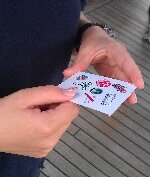
Distribute one card (there’s 54 in the pack) to each person in your group. Describe that that there are two sides to each card, every one of them different.
On one side, there is a large picture of a unique object such as a hammer, a rubber chook or a model train. On the other side, there are 8 smaller images selected from the 54 larger items. Somehow (and I’m not a mathematician) any two cards will have one item in common among these 8 images. Crazy, I know! But it works every time.
Ask everyone to mingle and find a partner. On the count of “1, 2, 3″ each person flashes the 8-image side of their card to their partner. The first person to identify the common image / object, earns a brownie point!
From this point, you can take one of many routes. For example, once the match is identified, ask each partnership to have a quick chat to discover at least one thing that they have in common – but – encourage them to look beyond the obvious. Then, each person swaps Ubuntu cards, and returns to mingling and seeks out a new partner. And repeat many times.
 Variations
- As above, but this time, partners stand back to back. One person starts by describing one of the 8 smaller objects on his/her Ubuntu card – but, without using the object’s name. They can describe its use, colour, shape, where it may be found, etc. Once a match is discovered, partners turn around and continue to share as above.
- Click here to read several more Ubuntu Card variations posted on the official Ubuntu Collaborative Resource page (as moderated by my good friends Ryan McCormick & High-5 Learning Adventure Center, USA).
If you are already using Ubuntu cards, why not post your favourite variation by clicking here…
Click here if you want to get your own Ubuntu card set?
Copy Claps
Wonderfully engaging non-verbal opener for large groups.
At A Glance
Without saying a word, a leader initiates a series of claps – each one slightly more complex than the one before – inviting the group to copy their moves.
What You Need
- 1 minute
- A large group, the bigger the better
What To Do
Start by saying nothing. Simply get people’s attention (look at video for a good example) and initiate your first simple, single clap. Make it loud and proud. Most folks will follow suit.
Then, respond with two claps (the group copies) and then three claps. By now, the group will have caught on to what’s going on.
You whole object now is to continue to present a series of increasingly complex (yet still fun) claps and slaps until the group reaches the point of utter bemusement. End with a courteous series of claps that morph into applause.
You will now have your group’s attention, they will be smiling, and are ready to hear what you have to say.
Variations
- The sky’s the limit – introduce a variety of sounds from whistles, thigh-slaps, hoots and hollering! Just make it fun.
- See Clapping Game in Count Me In: Large Group Activities That Work (p 86) for another excellent energiser that is guaranteed to raise the energy of your group and make ‘em laugh!
Thanks Nate for sharing this little gem.
Want to make a comment? Please let me and the world know by clicking here…
Train Station Greetings
An hilarious, silly exercise to energise your group.
At A Glance
Two people spy each other on opposite sides of the group and approach one another in ‘slow-motion’ until they are within a metre of each other, and then suddenly they each turn away and look for a new person to start the process over again.
What You Need
- Large group, of say 30+ people
- 5 mins
What To Do
Your sequence and framing of this exercise are very important, so approach with care. If you present when the group is not ready to ‘play’ and act a little silly, it could bomb.
With your group huddled around you (or standing in a circle, doesn’t matter), suggest that you would like everyone to imagine that they are waiting on a train platform in the good old days to meet a long lost friend.
By demonstration, you see them (on the other side of the group to where you are standing) and start waving madly and moving towards them – BUT, in slow-motion. All movements, gestures and sounds are in slo-mo.
By way of a volunteer, ask someone (you have spied) to adopt a similar slo-mo approach to you. Then, suddenly when the two of you are about a metre apart, you discover to your mutual horror that this person is not who you thought it was, and quickly look away.
Eah person then randomly spies a new ‘long lost friend’ (on the other side of the group to them) and they resume the same slo-mo approach toward one another, etc, etc.
Variation
- As above, but perform all of the slo-mo greetings without sounds.
Want to make a comment? Please let me and the world know by clicking here…
Who! by Karl Rohnke
A name game you can play with a large group.
At A Glance
Standing in the centre of a circle of people, a person points to someone and yells “Who” inviting them to trade places, before the new person repeats the sequence.
What You Need
- 5-10 mins
What To Do
Earlier this month, I visited Boston to be a part of Project Adventure’s 40th Anniversary celebrations. What a blast, especially to mix with the likes of Karl Rohnke and many other awesome PA staff and alumni.
Karl, Nate Folan (PA staffer) and I were invited to share a few games with everyone at the welcoming session, and this was Karl’s opener! Click here to view Clap Trap, another fun activity Karl introduced.
Start by asking your group to form a circle. With you in the centre, point to someone (perhaps, who you don’t know) in the circle and yell loudly ‘Who!” This will invite this person to walk towards you, and as you meet you could shake hands and exchange greetings, perhaps even using one another’s name.
You now move into the circle where the second person was standing, inviting the latter to resume the pointing and greeting routine.
Once it appears that the group has grasped what is going on, randomly introduce a second, third, fourth, etc persons into the centre of the circle to ramp up the energy and participation.
Variation
- For groups that already have a good level of ‘name-knowingness’, try Fill Me In.
Thanks Karl 
If you know of a fun variation to this game, please add a comment here …
Ice-Breaker Exchange
Simple, non-threatening game to get people interacting and sharing.
At A Glance
Starting with a question card each, partners ask each other the question on their card, before swapping cards and then seeking a new partner to ask their new question.
What You Need
- Set of Ice-Breaker Question cards
What To Do
 In advance, prepare a set of ‘ice-breaker’ type questions on a series of index cards – one question per card. There are hundreds of questions you could use, but to save time, click here for a set of 24 great ice-breaker questions ready to print onto index cards. As you develop more questions, make them as open, non-threatening and interesting as possible.
Next, randomly distribute one card per person. Then, ask each person to find a partner who has similar length of hair to them (or any other fun, random way of splitting your group into pairs).
The action starts with each person asking their partner the question on their card. After this person has responded, the partner asks the question on their card. Upon completing this exchange, they swap cards, and then each seek a new partner. Repeat over and over.
Variations
- Form groups of three or more, inviting each person in the group to respond to each question, before swapping cards and forming a new group.
- For more energetic groups, replace the questions with actions. For example, ‘Perform ten star-jumps in a row,’ ‘Shake the hand of five different people within 30 seconds,’ and ‘Run around the outside of the group as quickly as possible.’
If you know of a fun variation to this game, please add a comment here …
Acronyms
Hey folks, just received a note from a long-time client describing his joy at using a wonderful variation of one of my all-time favourite arrival activities – ACRONYMS!
He recently encountered your typical group of disengaged young people, and soon after he rolled out this exercise, he’d broken the ice and had them in fits of laughter.
First, here’s the activity…
At A Glance
A group attempts to decipher a variety of acronyms as they are presented one after another.
What You Need
- List of ‘acronyms’ printed on index cards or sheets of paper
- Paper and pens (optional)
- 10 – 20 mins
What To Do
You know how it feels when the clock says it’s time to start, but it’s obvious that not everyone is here. I hate waiting, so I have developed a bunch of really simple, non-threatening activities that can occupy (think reward) those folks who are on time, yet not disrupt the group’s fun when the late-comers finally appear.
Well in advance, grab a magazine, newspaper or both and start flicking through the pages spotting as many acronyms (you know, a word that is formed from the initials of other words) as you can. I’m sure you know many off the top of your head. Write these ‘words’ onto a set of index cards or sheets of paper. You’ll need at least 40 or more.
Can’t think of any? Check out pages 57 & 232 on Count Me In for dozens of them, such as:
PIN DOA QANTAS LASER NATO AD
ANZAC FAQ BBC BMW LED HMS
RAM FUBAR NIMBY ATM SCUBA pH
MGM WHO FUNN UFO DINK RSVP
MASH GSOH CEO UNESCO ISBN IVF
The basic idea is to present this series of cards, turning one card over at a time, asking your group to decipher as many of the acronyms as they can, in as little time as possible. Get it right (bing!) and you show the next card. Can’t work it out, either tell them the answer, or put the card aside to work on later as you move onto the next one.
As an opening (arrival) activity, let me describe my all-time favourite version…
I make an ‘unofficial’ start by asking people to bunch on in, sit them down (often on the floor), introduce myself briefly and pull out the cards. Within a few minutes and a dozen or so cards, I have not only fostered engagement and some laughter (I often encourage silly answers). I’ve found this to be an awesome, creative way to kick off many programs.
And, hey, did you know that A C R O N Y M is really an acronym? A Contrived Reduction Of Nomenclature Yielding Mnemonics, or Abbreviated Codes Rarely Or Never Yielding Meaning. Or, how about Annoyingly Cryptic References Of Names You Make-up?
Variations
- Separate into smaller groups, and hand each a number of acronym cards. Their object is to correctly guess as many as possible, perhaps within a time limit.
- As above, but this time add a number of blank index cards and supply a magazine or newspaper. Each small group is now challenged to find a variety of acronyms within the pages, write them on the blank cards, and invite another group to translate as many as possible.
- Use a series of common and humourous text / SMS abbreviations as your acronyms. Terms such as IMHO (in my humble opinion), LOL (laugh out loud, or lots of love), ISO (in search of), and tons of others*. Click HERE for a list of 50 of the most common SMS / Text phrases to get you started.
* Thanks to Andrew Davis, Wodonga VIC for this last variation
Taken from ‘Count Me In: Large Group Activities That Work.’
One Car – Two Siblings
** [note - if you've got a better name for this activity, please leave a comment here] **
Sitting in a train on my way to open a conference this week, looking for a novel opener, I came up with this fantastic idea (a twist to the wonderfully successful Commonalities) … and it worked a treat, so I wanted to share it with you.
It’s always tough to ‘break the ice’ when people are seated in rows, or in a lecture theatre, or round a table – hard to move people about. And this is exactly what I had to work with. Here’s what I did…
I asked people to partner up with one or two other people sitting close to them. After quick introductions are exchanged, I invited each group to have a conversation in which they sought out all the “things” they (all) had in common … but with one proviso. Starting at one, and moving through the numbers as high as they could go within three minutes, their object was to find that number of things / objects / experiences they had in common. As this explanation was met with a few blank faces, an illustration followed.
For example, starting at one, the group may discover that they all own ONE car. Then they might discover they all have TWO siblings. Moving on, they have all taken THREE overseas holidays, and all have FOUR letters in their first names, and so on.
On this particular morning, one group of three people got as high as EIGHT – apparently, they all had the numeral eight in their street address (which, maybe, is stretching the framework of the game – but who cares – they were talking and interacting and, best of all, along with 100 other people, were laughing and generating TONS of energy….)
… and voila – a new ice-breaker!
Try it out, and tell me what you think …
Commonalities
A fun way to get to know others in your group
At A Glance
Small groups develop a long list of things they have in common with each other, and then share them with the larger group to earn points for each unique attribute.
What You Need
- Pen and paper for each small group
What To Do
 This is one of those activities that somehow fell off the radar, and now, having just used it for the first time in 10 years, I’m all excited about it again.
Ask your group to divide into groups of 4 to 6 people – the size is not too critical, but any larger than 6 and the search for commonalities becomes more difficult.
Equip each group with a pen and paper, and then invite them to develop a list of attributes / things that everyone in their group has in common. Five minutes thinking time is normally long enough.
For example, after a quick discussion, a group may discover that they are all the eldest in their families, or they have all visited the Melbourne Zoo, or perhaps can sing the first line of a Beatles song. Whatever – “it” just has to be common to everyone in the group, and the group with the longest list of commonalities wins!
Now, at this point, some groups get a little too excited thinking that, given it’s a competition, they just list all of the really obvious things they have in common, such as “we’re all wearing clothes,” “we all have teeth,” “we all have mothers,” etc. Groups are welcome to add these very obvious attributes to their list, BUT…. (here’s the kicker), if at least one other group has the same attribute on their list, both groups must cross it off their tally.
Yep, not so easy anymore, and – purposefully – this rule encourages groups to look for the really interesting things they have in common. Such as “driven more than a kilometre with the hand-brake on” “all born by caesarean” and “been in an ambulance,” as just three worthy contenders I’ve actually heard.
Have FUNN…
Variations
- Do the opposite – ask your group to develop a list of things that no one has in common (altogether much more difficult) – that is, you are looking for “things” that only one person can lay claim to, eg “been struck by lightning,” “rolled an ambulance” and “never broken a bone.”
- Drop the “duplicate” rule, and inspire each small group to develop a really long list of things they have in common, allowing as many obvious attributes as possible. More a competition of quick thinking than creativity, perhaps.
Sticky Beak
Filed under: De-inhibitizers, FUNN Games, Ice-Breakers
A quick elimination exercise that is totally FUNN
At A Glance
With a small roll of masking tape sitting on the end of their noses, individuals attempt to ‘steal’ other people’s tape by gently pushing against the latter’s nose.
What You Need
- Roll of masking tape
What To Do
Just had to share with you this really simple, but totally hilarious activity I tried out for the first time last week with a group of students…
To save time, prepare a bunch of pre-cut/torn pieces of masking tape in advance, one piece for each person in your group. Cut each piece to approx 10cm in length.
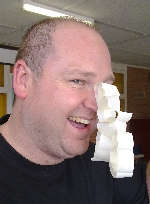 Ask each person in your group to grab a piece and then roll it into a circle where the two ends meet, whereby the sticky side is facing out. Then, invite each person to place this sticky apparatus onto the very end of their nose. For longer staying power and strength, people may clamp down the tape (using the inside of the sticky tube) onto their nose.
Finally, on “GO,” invite each person to engage with another, face off, and move gently towards the other in an attempt to have their sticky beak touch their partner’s sticky beak, then quickly pull back. In 9 out of 10 cases, one person will lose the tape from their nose, because it now sticks precariously to the end of their partner’s taped nose.
 The game continues with those who still posses a sticky beak attempting to eliminate all other competitors, until at last, one person remains – the winner! Keep your camera handy, because (evidently) the elongated masking-taped nose of the winner is worth a shot.
To get a sense of what you could end up with (thanks to Daryl, David, and er, .. me), I’ve added a couple of photos!
PS: It’s OK for people to occasionally tamp down on their original masking tape circle, to help it to remain stuck to one’s nose. But… mashing all of the accumulated tapes into one big sticky mess is not kosher!
 Variations
This is still new to me, but… do you know of any variations? If so, please share in the comments…
Jump In Jump Out
A crazy, energetic group exercise that will trigger tons of laughter
At A Glance
Holding hands in a circle, facing the centre, a group jumps in, out, left or right of the circle in synch with their leader’s instructions.
What You Need
- Open, flat space to form a circle
- 5 mins
What To Do
This exercise is almost impossible not to stuff-up – which is the whole point. I promise you, Jump In Jump Out WILL cause your group to laugh out loud.
Ask your group to form a circle, holding hands facing the centre. You then explain that you want them to …“SAYwhat I say, and DO as I say.” Next, you practice a few rounds, by calling one of four commands – Jump In, Jump Out, Jump Left or Jump Right.
The aim is for each person (the group) to repeat exactly what the leader says, at the same time they are copying what he/she does. Pretty simple, you’d think. Not! There is always a few people who move to their “other left” (or right) or just simply get confused, causing the circle to crinkle.
After 20-30 seconds, re-form the circle, and announce that you now want the group to “SAY THE OPPOSITE of what I say, and DO as I say.” Get it? For example, if I say “Jump In,” the group says “Jump Out” as they literally jump in. Whoooahh… just typing this out is doing my head in!
OK, give it a go. Expect tons of mistakes, confusion and laughter galore – and that’s exactly what you want.
But wait, there’s more…
Try one of these fun variations.
Variations
- Re-form the circle, and announce that you want the group to “SAY what I say, and DO THE OPPOSITE of what I say.” For example, if I say “Jump Left” the group is invited to say “Jump Left” as they jump to the right.
- Add extra commands, such as “Jump Twice” or “Jump High” or “Jump Two the Left/Right”.
Thanks to Paul Radcliffe, who passed on this gem to me during an Project Advenutre workshop in Boston, MA July 2010.
If you know of a cool variation to this ice-breaker, please add a comment…
Elevator Air
Filed under: De-inhibitizers, Ice-Breakers, Warm-Ups & Stretches
A gentle, yet experiential way to introduce the desired tone of your program.
At A Glance
People cross to the other side of the circle in which they are standing in the manner of various ‘mind-states.’
What You Need
- A flat, open area to accommodate a wide circle.
- Minimum of 10 people.
- 5 – 10 minutes.
What To Do
Everyone knows what it means to be in an elevator. You step in, no one looks at you, you press the button for your floor. Doors close, and you instinctively glance up at the numbers blinking above the doors as if it holds the answer to the meaning of life. Moments pass, and you glance up again and can’t believe that you still have 10 floors to go. You can’t wait to get out… you know how it goes.
Share a little of this with your group, to get them ready for the what’s next. It will often spark a chortle or two, perhaps even a few comments about how dumb this all seems. Which, if this happens, is just perfect, and I recommend you allow it to occur.
Starting with a large circle, invite every person to simply walk to the other side of the circle from where they are standing as if they had just entered an elevator. No talking, barely any eye contact, and certainly no interaction. Take note of what happens, how it feels, etc. This is ‘Elevator Air.’ Ask your group to comment on how it felt for them.
Okay, ask everyone now to return to their original spots in the circle, but this time as if they were entering a room full of people they knew and had not seen in a long time. This is ‘Long Lost Air.’ Again, observe what happens. Without even saying it, I can guarantee they will instinctively go out of their way to interact with one another.
Now, put it to the group, which atmosphere felt the most comfortable? Which atmosphere do you believe would be the most productive? You can probably see where this is heading, right?
Take just a few moments to establish what caused the difference, and to connect this to your program. Typically comments such as “it was safer”, “I felt trusted”, “I knew everyone better”, “I was able to take risks” will be offered. Fantastic! Suggest that this is exactly what you hope to achieve with your program, and importantly, you invite every member of your group to take responsibility for creating this atmosphere right here, right now. You’re ready to move on.
Variations
- If your group needs a little warming up between ‘Elevator’ and ‘Long Lost’ Air, try ‘Highway Air’ – you know, that generally friendly, safe and more curious way we are with others when we are driving our cars as we acknowledge others in the vehicles. But of course, avoid any ‘road rage’ suggestions.
- Add a further (final?) crossing in the manner of walking into a wild party. Discussion can still follow which looks at the impact of “being” this way with people. For some, this will be very positive / fun, but for others, perhaps scary.
Taken and adapted from ‘No Props: Great Games with No Equipment’
If you know of a cool variation to this ice-breaker, please add a comment…
Mintie Game
An awesome mixer that is as effective as it is delicious
At A Glance
Starting with 10 treats each, people aim to earn more treats by causing as many people as possible to say the word “YES” in their ensuing conversations.
What You Need
- 10 ‘Minties’ or other sweet treats (preferably wrapped), per person
- 5 – 10 mins
What To Do
Ohhhh, this seems so easy to do, but I swear the simple exercise of not saying “YES” is so hard.
I first played this game with ‘Minties’ (refreshingly chewy mint lolly), but it works just as well with any sweet treat. Distribute an exact number, say 10, to everyone in your group, and then just as quickly, tell them not to eat them – just yet!
Now, invite your group to mix and mingle with each other, engaging in conversation as often as possible. Encourage them to introduce themselves, exchange pleasantries etc, etc, and then engage in the fine art of conversation. But this is not just any form of conversation; your goal is to cause the other to say the word “YES.” Every time your partner utters this pleasantly uncomplicated word, you gain a Mintie. The person with the most Minties at the end ‘wins.’
My favourite line to gain a quick Mintie? I spy anyone on their own, approach them and calmly ask “Do you have any Minties left? “Yes I do, er…arghhhhhh..” Works like a charm.
Variation
- Substitute the word “YES” with other colloquially popular words such as “LIKE,” and if you want to make it really difficult – the word “AND.” It’s near impossible!
Taken from ‘Count Me In: Large Group Activities That Work!
If you know of a cool variation to this activity, please add a comment…
Clumps
Zany, fast-paced energiser designed to mix people frequently
At A Glance
People quickly form a series of temporary groups matching the number called by the leader.
What You Need
- 5 – 10 mins
What To Do
This is so simple, yet so good. Gather your group around you, and explain that, in a moment, you will shout out a number – any number from, say one to ten (the bigger your group, the bigger you can make the top end). Immediately, everyone must form a group consisting of that number of people. In my experience, groups get very huggy at this point, and form little fortresses with their bodies to prevent others from joining their little huddle.
Naturally, you will often get a few poor souls left over, the so-called remainder, if we speak in the language of long division. At this moment, you have several options. You can eliminate these folks, move them to the side, and continue with the next shouted number, and so on until you get the lucky ‘winners.’ This is fine; however, I think it’s best to simply shout another number. It keeps the energy up, is much less competitive, and more fun for everyone. And the look on the faces of the ‘dejected’ when they hear the next number called (‘I’m saved’) is priceless.
Move from five to three, then up to nine and back down to four so that a high degree of mixing occurs. Shout “ONE!” just to see what happens.
Variations
- Add the proviso that when a new number is called, a person cannot form a group with anyone who was in their previous group (as much as is possible). This tweaking of the rules will spoil the plans of those crafty individuals who prefer to stick together, simply opting to ebb and flow in terms of their membership number at any point in time.
- Form a group according to a simple, easily-accessible category, such as dark-coloured tops, brand of running shoes, gender, colour of eyes, etc. Similar to Categories.
- Once formed, instruct the newly-created groups to use their collective bodies to make the shape of a letter of the alphabet, or numeral, or object, e.g., table, house, car, etc.
Taken from ‘Count Me In: Large Group Activities That Work’
If you know of a cool variation to this exercise, please add a comment…
Let Me Introduce
An exercise where you introduce everyone else but yourself
At A Glance
Each person approaches as many people as possible within a specified time limit, introducing each of them to another person in the group.
What You Need
- 2 – 5 mins
What To Do
I’ve found this simple re-working of the traditional form of introductions a brilliant way to rid my group of a lot of that tension that most people experience when they first get together. It won’t evaporate all of the awkward feelings, but it is fun and is guaranteed to create a ton of energy.
With your group milling about, ask them to casually approach any other person in the group – whether they know their name or not – greet them, and ask for their name. Embodied with a lively demonstration, it will sound something like this. “Hi, what’s your name?” The doe-eyed person you have just approached says “Simon,” and you reply with “Hi Simon, come with me, I’d like to you to meet somebody.” At which point you lead Simon with you over to another unsuspecting group member, and say “Hi, what’s your name?” and it might be Vijay this time. “Hi Vijay. I’d like you to meet Simon. Simon this is Vijay.”
Having done the job of the Introducer, explain that each person now moves on to either seek a new person to greet, or submit to another person’s invitation to be part of their introduction, and so on. Get the idea?
In principle, the person arranging the introductions need not say their name, but we are so accustomed to doing so in our culture, it often happens anyway!
To give the exercise a little vivacity, announce that your group has three (or whatever) minutes to introduce everyone to everybody else. Won’t happen, but that’s not the point.
Variation
- Following on from the basic set-up, one of the two people who have just been introduced to each other, now leads the other to a new person. For example, Simon leads Vijay over to meet and greet with Rachel.
Taken from ‘Count Me In: Large Group Activities That Work’
If you know of a cool variation to this exercise, please add a comment …
Categories
The perfect ice-breaker – ideal for mixing people in a fun and non-threatening manner
At A Glance
Your group splits into a variety of smaller groupings, according to a series of categories you announce.
What You Need
- 10 – 20 mins
What To Do
Ask your group to separate according to the categories or groupings you are about to announce. For example, if the category is “Colour of your pants,” everyone wearing blue jeans will group together. Sometimes, individuals may find themselves alone, but in most cases, small groupings of commonality will develop. Upon identifying each of the groups, announce the next split. You can keep splitting folks for as long as they are having fun, or you run out of ideas.
For mixing purposes, alternate between two-group splits and multi-group splits. The idea is to invite your group to meet as many new people as possible. To this end, if you have the time and the inclination, as soon as the groups have formed, give the participants a few moments to say hello to one another, or perhaps share something of relevance to the category, e.g., “What was so cool about being the oldest / youngest / in-between child in your family?”
Here are just a few sample and fun group categories. There are simply hundreds of them out there, so please, don’t hesitate to make up your own, or tempt them from your group.
Simple half-half splits:
- Arm that ends up crossed over the top of the other, when folded on your chest.
- Leg you put into your pants, shorts, underwear, etc. first when dressing.
- Preference for cooking or cleaning up.
- Preference for washing or drying dishes.
- Position of your thumbs, that is left or right on top, when you clasp your hands together so that your fingers interlock.
- Last digit of your home telephone number. All the odd numbers – 1, 3, 5, 7 or 9 – get together, and the even numbers do the same.
- When presented with a ‘good news / bad news story,’ which do you prefer to hear first?
- Preference for the way toilet paper spills off the roll – like a waterfall, over the top and forward, or against the back towards the wall.
- Number of street you live at – odds and evens.
Simple multi-group splits:
- Month / zodiac sign in which you were born.
- Number of continents you have visited.
- Number of siblings in your family, including yourself.
- Colour of your eyes, hair, socks, etc.
- Type of shoes you are wearing (not necessarily their brand).
- Which shoulder(s) you hold a carry-bag – right, left or both shoulders.
- How often you shave each week?
- Distance you have travelled to get here (use clumps of distances, such as 0-5 km, 5-10 km, etc.
- Number of items you recycle at home, e.g., plastic, glass, tin, paper, etc.
Variation
Use to divide a large group into roughly random and even teams. If you are looking for an even split, and just don’t seem to find a category that fits, simply use the old scientific method of indiscriminately moving a few people (“Hey, you and you, move over here.”) to even out the groupings.
Taken from ‘Count Me In: Large Group Activities That Work’
If you know of a cool variation to this exercise, please add a comment…
Cocktail Party
A quick name reinforcer, and welcome segue to a drink’s break.
At A Glance
People mingle about shaking hands and greeting people by name as quickly as possible.
What You Need
- A flat, open space for mingling.
- As many party-goers as you can muster.
- 2 minutes.
What To Do
Looking for a quick way to wrap up a session, perhaps reinforce a few names people may have just learned, and throw to a drinks break? This is it.
Invite people to bunch around you, capturing the image of palatial surroundings, evening gowns, black ties and cocktails. Suggest that each person holds in their left hand an imaginary drink, or cocktail if they choose. Then, on your signal, everyone is encouraged to meet, shake the hands of and greet as many people at the party as possible, in say, 43.5 seconds (this is not a magic number!).
On “go”, it will sound something like, “Oooohh, darling, so good to see you Peter. I’m having a frightfully good time…..”. Chat for a few moments, discuss drinks, recent holidays to the Swiss alps, and then in typical cocktail party fashion, interrupt the conversation with a “O, petal, must keep moving”. Air kiss, kiss (these are not mandatory), and “…bye bye” off you go to greet another party guest.
Suggest to your group that they should use the other person’s name as often as possible, enquire about the other person’s drink (remember, they are holding on to it), but not spend too long with any one person. For a bit of fun, ask someone for the time and see if they spill their drink!
When you feel like the heat has started to dissipate from the party, quell the action and ask your group what is odd about this activity. Someone usually will remark that “there is no drink in their hands”, which is your cue to say….let’s remedy that situation – time for a break.
Variations
Imagine you are in a swanky Food Hall. Invite people to mingle as they treat themselves to the extraordinary array of fine foods available on people’s trays.
Taken from ‘No Props: Great Games with No Equipment’
If you know of a cool variation to this exercise, please add a comment…
Fill Me In
A name reminder game featuring a chaotic combination of movements.
At A Glance
People assume the place of a person standing in the circle whose name they have just called.
What You Need
- A flat, open space.
- Minimum of 10, and up to 30, more if your group has a good level of name-knowingness.
- 10 – 15 minutes.
What To Do
Having formed a circle, the action begins when one person steps into the circle – at the same time announcing the name of someone who is on the other side of the circle to them – and walks toward that person. The first person fills the space of the newly announced person as this second person moves into the centre of the circle and immediately calls out a third person’s name, and the process starts all over again.
In and out, in and out it goes on. At a point you believe the group is ready for more, introduce a second and third person calling out a name across the circle. A series of chaotic and confusing crossings will result. At this time, encourage lots of eye contact and careful movements.
Variations
- Invite the person who has called out a name, to introduce themselves by name to the other, perhaps shake hands, before this other person repeats the process.
- As the movement of people in the centre of the circle gains momentum, invite people to shake the hand and greet (using the name) of someone as they pass them in the middle of the circle.
Taken from ‘No Props: Great Games with No Equipment’
If you know of a cool variation to this exercise, please add a comment…
-
Who am I?

Hi, I'm Mark Collard.
This blog shares some of the most successful group games, team-building activities & programming tips I know.
--| FREE ACTIVITY eBOOK |--

Enter your name and email address in the form below to receive a FREE 30 page ebook which features ten of the BEST ice-breakers & group games I know!
Share: Tell others about this site...

@markcollard