
Copy Claps
Wonderfully engaging non-verbal opener for large groups.
At A Glance
Without saying a word, a leader initiates a series of claps – each one slightly more complex than the one before – inviting the group to copy their moves.
What You Need
- 1 minute
- A large group, the bigger the better
What To Do
Start by saying nothing. Simply get people’s attention (look at video for a good example) and initiate your first simple, single clap. Make it loud and proud. Most folks will follow suit.
Then, respond with two claps (the group copies) and then three claps. By now, the group will have caught on to what’s going on.
You whole object now is to continue to present a series of increasingly complex (yet still fun) claps and slaps until the group reaches the point of utter bemusement. End with a courteous series of claps that morph into applause.
You will now have your group’s attention, they will be smiling, and are ready to hear what you have to say.
Variations
- The sky’s the limit – introduce a variety of sounds from whistles, thigh-slaps, hoots and hollering! Just make it fun.
- See Clapping Game in Count Me In: Large Group Activities That Work (p 86) for another excellent energiser that is guaranteed to raise the energy of your group and make ‘em laugh!
Thanks Nate for sharing this little gem.
Want to make a comment? Please let me and the world know by clicking here…
Simon Says … Revisited
No doubt you’ve played ‘Simon Says…’ at some point. Maybe it features heavily in your repertoire already? If not, I’d suggest it’s time to add it back in.
Here’s a couple of ideas that came up for me during Michelle Cumming’s recent workshop:
- Rather than eliminate folks who move or flinch when they shouldn’t, ask them to simply count the number of times they make a ‘mistake’ – this option elevates the level of engagement; and
- Use ‘Simon Says…’ to move your group from point A to point B. Everyone starts at one end – in a line or bunched up, it doesn’t matter – and issue a series of commands as Simon moves your group from one side of the gym, or playing field, etc to the other. If someone makes a mistake, ask this person to return to the starting line, or, better still, adopt the above friendlier option.
Have FUNN 
Do you know an even better variation? Please let me and the world know by clicking here…
Knee Tag
Quick, simple tag exercise for groups of four or more.
At A Glance
In pairs, individuals attempt to tag the uncovered knees of their partner as often as possible.
What You Need
- An open, flat space.
What To Do
 Divide your group into pairs, and ask each partnership to stand facing one another about a metre apart, and place their hands on their own knees.
Explain that a knee can only be tagged when it is not covered by that person’s hand. Also, a person is only entitled to move their feet when they place their hands on their stomach (ie leaving their knees uncovered). So all movements will occur with hands on tummies, and only when he/she stops moving can an individual cover their knees.
All tages are made with an open hand. Play several 30 second rounds, then swap partners.
Variations
- Allow every person to tag any other person.
- As above, but introduce the “Hands Up” rule. When this command is called, everyone must keep their hands on their tummies and never defend their knees. Only when “Hands Down” is called, may participants choose to cover their knees.
If you know of a cool variation to this game, please add a comment…
Adapted from Knee Tag in ‘Count Me In: Large Group Activities That Work’
Simon Says Stretch
A golden oldie enhanced with several great variations.
At A Glance
Participants attempt to strictly follow a series of physical instructions on your command, or be eliminated.
 What You Need
- Flat, open space.
What To Do
Ask your group to stand directly in front of you, in a circle, in lines, or distributed evenly throughout an area, where every person has ample space to move.
Explain that your name is ‘Simon’ and you are the leader, which means that everything you command must be followed – exactly!
However, this trick is, only those commands that are prefaced with the words “Simon Says…” should be obeyed.
Start by announcing that you will only ever command the following moves: Left Arm UP, Left Arm DOWN, Right Arm UP and Right Arm DOWN. Or, Both Arms UP or Both Arms DOWN.
As with all commands, I recommend that you add a matching movement to your command (or not!).
Explain that once the game starts, if anyone initiates or completes a move without the command “Simon Says…” – or performs the wrong move – they simply add a point to their total. Or, you could simply eliminate them, but aiming to score the least number of points is much more fun!
To build suspense, issue a series of “Simon Says…” commands one after the other, and then quickly follow up with an instruction sans the “Simon Says…” piece.
Variations
- As above, but substitute your commands with any series of fun movements and stretches, such as Jumping Jacks, Sit Ups, Attention, etc.
- Introduce a championship round in which you add the command “Simon Says … Clap Your Hands Once (Twice, etc).”
- Click here for latest fun “Simon Says…” variations.
Do you know a fun variation? Please add a quick comment by clicking here…
Circle Tag
A tag game that will have your group running in circles.
At A Glance
Starting in a circle, individuals run clock-wise in an attempt to tag as many people in front of them until they are tagged and eliminated from the game.
What You Need
- Flat even ground on which to run
- Chalk or boundary markers
What To Do
Having picked the perfect spot to conduct a lot of running, ask your group to form a large circle, with about a metre between each person. Using chalk or boundary markers (not rope), mark the inside of the circle where people are standing.
Next, explain that everyone’s goal is the same – to stay in the game as long as possible, and maybe even, be the last person standing. Then, on your command “GO,” instruct everyone to run clockwise on the outside perimeter of the circle tagging any person in front of them. Or, in other words, everyone is “IT,” but everyone (taggers and taggees) must run in the same direction.
You should expect within 10 seconds or so, more than 2/3 of the group will have been eliminated. Ask all eliminated persons to assume a position standing on the boundary (this also keeps the chasing to the outside of the circle).
Gradually, fewer and fewer people are left chasing each other, and ultimately, one person remains. Ta da!
Variation
- For smaller groups, of say only 10 people, each person is entitled to be tagged 2 or 3 times (you decide) before they are eliminated.
If you know of a cool variation to this exercise, please add a comment…
Acronyms
Hey folks, just received a note from a long-time client describing his joy at using a wonderful variation of one of my all-time favourite arrival activities – ACRONYMS!
He recently encountered your typical group of disengaged young people, and soon after he rolled out this exercise, he’d broken the ice and had them in fits of laughter.
First, here’s the activity…
At A Glance
A group attempts to decipher a variety of acronyms as they are presented one after another.
What You Need
- List of ‘acronyms’ printed on index cards or sheets of paper
- Paper and pens (optional)
- 10 – 20 mins
What To Do
You know how it feels when the clock says it’s time to start, but it’s obvious that not everyone is here. I hate waiting, so I have developed a bunch of really simple, non-threatening activities that can occupy (think reward) those folks who are on time, yet not disrupt the group’s fun when the late-comers finally appear.
Well in advance, grab a magazine, newspaper or both and start flicking through the pages spotting as many acronyms (you know, a word that is formed from the initials of other words) as you can. I’m sure you know many off the top of your head. Write these ‘words’ onto a set of index cards or sheets of paper. You’ll need at least 40 or more.
Can’t think of any? Check out pages 57 & 232 on Count Me In for dozens of them, such as:
PIN DOA QANTAS LASER NATO AD
ANZAC FAQ BBC BMW LED HMS
RAM FUBAR NIMBY ATM SCUBA pH
MGM WHO FUNN UFO DINK RSVP
MASH GSOH CEO UNESCO ISBN IVF
The basic idea is to present this series of cards, turning one card over at a time, asking your group to decipher as many of the acronyms as they can, in as little time as possible. Get it right (bing!) and you show the next card. Can’t work it out, either tell them the answer, or put the card aside to work on later as you move onto the next one.
As an opening (arrival) activity, let me describe my all-time favourite version…
I make an ‘unofficial’ start by asking people to bunch on in, sit them down (often on the floor), introduce myself briefly and pull out the cards. Within a few minutes and a dozen or so cards, I have not only fostered engagement and some laughter (I often encourage silly answers). I’ve found this to be an awesome, creative way to kick off many programs.
And, hey, did you know that A C R O N Y M is really an acronym? A Contrived Reduction Of Nomenclature Yielding Mnemonics, or Abbreviated Codes Rarely Or Never Yielding Meaning. Or, how about Annoyingly Cryptic References Of Names You Make-up?
Variations
- Separate into smaller groups, and hand each a number of acronym cards. Their object is to correctly guess as many as possible, perhaps within a time limit.
- As above, but this time add a number of blank index cards and supply a magazine or newspaper. Each small group is now challenged to find a variety of acronyms within the pages, write them on the blank cards, and invite another group to translate as many as possible.
- Use a series of common and humourous text / SMS abbreviations as your acronyms. Terms such as IMHO (in my humble opinion), LOL (laugh out loud, or lots of love), ISO (in search of), and tons of others*. Click HERE for a list of 50 of the most common SMS / Text phrases to get you started.
* Thanks to Andrew Davis, Wodonga VIC for this last variation
Taken from ‘Count Me In: Large Group Activities That Work.’
Head Butt Tag
A fast-paced tag in which you are both the chased and chasee.
At A Glance
On “GO,” everyone declares themselves as belonging to one of two teams, and the chase resumes until everyone on the opposing team is tagged.
What You Need
- A large, flat open space
- Minimum of 10 taggers
- 5 – 10 minutes
What To Do
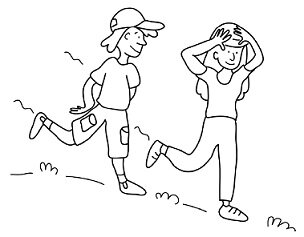 An early highlight of this game occurs right at the start when you roll into, “… Okay everyone, we’re going to play head-butt tag now!…” But don’t worry, it’s not what it seems, but at least you have your group’s attention.
Instruct your group to spread themselves randomly about the playing field / space. Explain that there are two “teams” – heads and tails (or butts) – and everybody gets to choose which team they (initially) want to belong. To be on the “heads” team, a participant must place both of their hands on top of their head, while everyone belonging to the “butts” team will place their hands on their bottom (not somebody else’s!)
From the centre of the field, you announce that you will count to three quickly, at which point everyone must have declared an affiliation with either the “heads” or “butts” team. On three, the chase begins. Heads chase butts, and butts chase heads. When a tag is made of a member on an opposing team – by removing one hand from a head or butt to touch another – the person who is tagged automatically becomes a member of the team that just “caught” them.
Loyalties may swap many times in a game. It continues until everyone swears allegiance to the same team, or it seems that most people are pooped!
Variations
- Toss a coin in the middle of the field, and shout the heads or tails outcome. The team which is announced chases the other team. Play several quick rounds, the game continues until everyone is caught.
- Rather than nominate just two teams, allow each person to choose any part of their anatomy to place their hands on, for example, their chest, shoulders, ears, etc. Same rules apply – the person tagged assumes the “team” position of the person who tagged them. This variation takes much longer, but only if you’re willing to let it run full-time.
Taken from ‘No Props: Great Games with No Equipment’
If you know of a cool variation to this exercise, please add a comment…
Jump In Jump Out
A crazy, energetic group exercise that will trigger tons of laughter
At A Glance
Holding hands in a circle, facing the centre, a group jumps in, out, left or right of the circle in synch with their leader’s instructions.
What You Need
- Open, flat space to form a circle
- 5 mins
What To Do
This exercise is almost impossible not to stuff-up – which is the whole point. I promise you, Jump In Jump Out WILL cause your group to laugh out loud.
Ask your group to form a circle, holding hands facing the centre. You then explain that you want them to …“SAYwhat I say, and DO as I say.” Next, you practice a few rounds, by calling one of four commands – Jump In, Jump Out, Jump Left or Jump Right.
The aim is for each person (the group) to repeat exactly what the leader says, at the same time they are copying what he/she does. Pretty simple, you’d think. Not! There is always a few people who move to their “other left” (or right) or just simply get confused, causing the circle to crinkle.
After 20-30 seconds, re-form the circle, and announce that you now want the group to “SAY THE OPPOSITE of what I say, and DO as I say.” Get it? For example, if I say “Jump In,” the group says “Jump Out” as they literally jump in. Whoooahh… just typing this out is doing my head in!
OK, give it a go. Expect tons of mistakes, confusion and laughter galore – and that’s exactly what you want.
But wait, there’s more…
Try one of these fun variations.
Variations
- Re-form the circle, and announce that you want the group to “SAY what I say, and DO THE OPPOSITE of what I say.” For example, if I say “Jump Left” the group is invited to say “Jump Left” as they jump to the right.
- Add extra commands, such as “Jump Twice” or “Jump High” or “Jump Two the Left/Right”.
Thanks to Paul Radcliffe, who passed on this gem to me during an Project Advenutre workshop in Boston, MA July 2010.
If you know of a cool variation to this ice-breaker, please add a comment…
Elevator Air
Filed under: De-inhibitizers, Ice-Breakers, Warm-Ups & Stretches
A gentle, yet experiential way to introduce the desired tone of your program.
At A Glance
People cross to the other side of the circle in which they are standing in the manner of various ‘mind-states.’
What You Need
- A flat, open area to accommodate a wide circle.
- Minimum of 10 people.
- 5 – 10 minutes.
What To Do
Everyone knows what it means to be in an elevator. You step in, no one looks at you, you press the button for your floor. Doors close, and you instinctively glance up at the numbers blinking above the doors as if it holds the answer to the meaning of life. Moments pass, and you glance up again and can’t believe that you still have 10 floors to go. You can’t wait to get out… you know how it goes.
Share a little of this with your group, to get them ready for the what’s next. It will often spark a chortle or two, perhaps even a few comments about how dumb this all seems. Which, if this happens, is just perfect, and I recommend you allow it to occur.
Starting with a large circle, invite every person to simply walk to the other side of the circle from where they are standing as if they had just entered an elevator. No talking, barely any eye contact, and certainly no interaction. Take note of what happens, how it feels, etc. This is ‘Elevator Air.’ Ask your group to comment on how it felt for them.
Okay, ask everyone now to return to their original spots in the circle, but this time as if they were entering a room full of people they knew and had not seen in a long time. This is ‘Long Lost Air.’ Again, observe what happens. Without even saying it, I can guarantee they will instinctively go out of their way to interact with one another.
Now, put it to the group, which atmosphere felt the most comfortable? Which atmosphere do you believe would be the most productive? You can probably see where this is heading, right?
Take just a few moments to establish what caused the difference, and to connect this to your program. Typically comments such as “it was safer”, “I felt trusted”, “I knew everyone better”, “I was able to take risks” will be offered. Fantastic! Suggest that this is exactly what you hope to achieve with your program, and importantly, you invite every member of your group to take responsibility for creating this atmosphere right here, right now. You’re ready to move on.
Variations
- If your group needs a little warming up between ‘Elevator’ and ‘Long Lost’ Air, try ‘Highway Air’ – you know, that generally friendly, safe and more curious way we are with others when we are driving our cars as we acknowledge others in the vehicles. But of course, avoid any ‘road rage’ suggestions.
- Add a further (final?) crossing in the manner of walking into a wild party. Discussion can still follow which looks at the impact of “being” this way with people. For some, this will be very positive / fun, but for others, perhaps scary.
Taken and adapted from ‘No Props: Great Games with No Equipment’
If you know of a cool variation to this ice-breaker, please add a comment…
Dead Ant Tag
A crazy tag that involves a little co-operation.
At A Glance
Upon being tagged, a person is obliged to lie on their backs with arms and legs extended into the air, and wait to be lifted by others to a designated spot, at which point they can return to the game.
What You Need
- A large, flat open space with boundaries.
- Minimum of 10 ants.
- 5 – 10 minutes.
What To Do
Make up whatever story you care to tell your group (such as “someone has just kicked off the top of an ant-nest, and all of the ants are now frantically searching for their home”), and then spread your “ants” all about your space. Then clearly designate one or more areas as “ant farms.” Ask for a volunteer who would like to be “it” first, and on “go,” this person runs around trying to tag everybody else. Pretty basic set up so far.
Next, explain that when a person is tagged, they are obliged to suddenly drop to the ground and, lying on their backs, wiggle their arms and legs into the air exclaiming “dead ant, dead ant” ad nauseam. This will act as an emergency signal to all other still-in-the-game ants to rescue one of their own. These paramedic ants (no more than four) will grab one or more limbs of the dead ant, and lift them gently to the safety of the closest “ant farm”. As long as the paramedic ants remain in contact with the dead ant, they can not be tagged by “it,” ie this is just one incentive to save souls.
Upon being gently placed (notice, I have used the word gently twice now!) onto the spot of the ant farm, the dead ant will experience a miraculous recovery and swing back into the game. And so it goes on.
Variations
- For really large groups, introduce two or more ants.
- Designate an area that is somewhat to the periphery of the action representing an “abandoned picnic”. Each ant is now called to visit the picnic –eating the scraps, so to speak – as many times as possible, by placing any part of their body inside the designated area. For each visit, the group gets a nominal point (or crumb), and collectively the group will work to earn as many points as possible. Of course, they must continue to save lost souls in the process.
- Just for the fun of it, call “dead ants” anywhere, anytime (ie long after you have played), and watch as people just drop to the floor and wiggle their way through a impulsive “dead ant, dead ant” chorus.
Taken from ‘No Props: Great Games with No Equipment’
If you know of a cool variation to this activity, please add a comment…
Clothes Peg Tag
Excellent for stimulating lots of energy and action
At A Glance
Armed with a swag of clothes-pegs, a person will aim to attach as many pegs on other people, while also trying to dodge extra pegs being pinned on them.
What You Need
- A big bag of clothes-pegs
- 10 – 15 mins
What To Do
Collect as many pegs as would supply 4 to 8 pegs per person. Then distribute this same number of pegs to everyone in your group, and ask them to pin them onto their clothing somewhere. The pegs need to be accessible, that is, somewhere on the upper torso, preferably on the back, front or arms of the clothing.
I doubt you will need boundaries for this activity, because the fun is always in the centre, but go ahead and set them if necessary. On “GO,” everyone aims to take as many of their own pegs off their clothing (one at a time), and attach them to other people’s clothing. To be clear, all pegs must remain on a person’s clothing except for the one they are trying to attach to someone else. Naturally, it’s not a one-way street; often when a person is not looking, they don’t suspect that someone is slyly pinning a peg on their back.
Run the game for as long as you feel there is energy, then stop and count each person’s stash of pegs. Pretty simple, the person with the least wins.
Variation
- Try it in reverse. Everyone aims to steal as many pegs from others in their group and attach them to their clothing.
Taken from ‘Count Me In: Large Group Activities That Work’
If you know of a cool variation to this activity, please add a comment…
Moon Walking
The closest people can get to flying without wings
At A Glance
Two people holding the lower arms of a third person whose hands are on his or her hips, physically support the latter as he or she jumps into the air.
What You Need
- 2 – 5 mins
What To Do
Use a variety of Clumps, ending with “THREE” to form random groups of three people. Ask one person to place hands on hips (thumbs pointing backwards) and to hold this stance firm. Instruct the two others of this triad to approach the first person, and grab a lower arm each with their two hands, often placing one hand at the wrist and the other just below the elbow.
Upon engaging in this exercise, allow people to choose where is best for them to place their hands. What is important to stress, however, is gentle but firm grips, and that the middle person maintains a solid stance at all times.
Now, commence the countdown, and ask each of the middle people to jump high into the air. At the same time, their partners will lift their colleagues gently into the air giving extra support to allow for a jump which is higher than can normally be expected. Note, I said “gently” and “extra support” – not fling, heave or toss your jumper into the air!
Depending on your sequence, this could be one of the first occasions in which you have introduced some form of exhilarating physical rush for your participants. It will often elicit much applause and screams (of joy). Apart from the obvious merriment of jumping really high, this is also an excellent activity to introduce your group to the concept of taking care of others – which, in turn, contributes to building a feeling of trust, support and community.
Hence, your sequencing must be spot on. Do not introduce this exercise to your group unless they have already exhibited healthy levels of safety consciousness in your lead-up activities.
Variation
- Same set-up as above, but this time, invite the threesome to move forward five paces, stepping forward in rapid succession with each jump. It will almost feel like flying.
Taken from ‘Count Me In: Large Group Activities That Work’
If you know of a cool variation to this activity, please add a comment…
Toe Tag
A hop-step-and-jump tag game that quickly raises the energy of your group.
At A Glance
Starting back to back, two partners spin around on “go” and try to “tag” the toe of their partner before they get tagged.
What You Need
- A flat, open space to accommodate lots of frenetic activity.
- Minimum of 2 toe-taggers.
- 2 – 5 minutes.
What To Do
This is a perfect 2 minute filler that has the power to transform your mopey group into a ball of energy.
You need groups of two people. Ask everyone to start with their backs to their partner, and on an appropriate signal like “go”, both partners spin around 180 degrees to face one another and engage in a dance-like combat. Each person attempts to “tag” the toe of their partner gently before one of their own feet gets tagged.
Be sure to remind your group that you said “tagged” and not “stomped” – this will make all the difference between many fun rounds, and a lot of sore feet. Play best of three rounds, but if you lose the first two, better make it five!
Variations
- If too much energy is expended chasing your partner, a less aerobic version is to start by facing your partner and holding their hands.
- Form a circle with your group holding hands. Each person attempts to “tag” the feet of their immediate neighbours. As soon as a person has had both feet tagged, they retreat from the circle, the group re-joins, and the game continues until the final two “toe taggers” duel.
Taken from ‘No Props: Great Games with No Equipment’
If you know of a cool variation to this tag game, please add a comment…
Mirror Image
Filed under: De-inhibitizers, Warm-Ups & Stretches
Excellent for stimulating mutual co-operation and plenty of unself-conscious stretching.
At A Glance
Facing each other, one person will reproduce the “mirror image” of the moves of their partner.
What You Need
- A flat, open space.
- Minimum of 2 people.
- 5 minutes.
What To Do
Ask people to find a partner who is about their height, and gather around. Start with a demonstration, inviting a volunteer to face you standing about half a metre apart. You initiate the action while the other person becomes your “mirror image”. Get that, it’s a mirror image, so if I extend my left arm out to my left-side, my partner will extend their right arm out to their right-side.
The intention is to make your movements interesting and slow enough for the other person to mime as if they were a full-length mirror. The enjoyment level is definitely enhanced by an initial zany presentation of unself-conscious stretching. Try not to succumb to typical “star jump” types of stretches – rather, for example, invent an innovative and fun morning “wake up” routine that includes having a shower, dressing in stretchy trousers and a long-sleeve angora sweater, etc.
Got a few laughs, it’s now time to turn it over to the group. The facial and physical gymnastics that result lets you see people like you’ve never seen them before. Swap roles after an appropriate time.
Variations
- After each partner has had their turn, ask them to try the anti-mirror (or reverse) image – during which the follower tries to mime exactly the opposite of their partner’s movement. Classic moves and total confusion are sure to follow.
- Repeat in groups of three or four people (all but one are the mirrors), but not too many more lest people get a little self-conscious.
Taken from ‘No Props: Great Games with No Equipment’
If you know of a cool variation to this stretch, please add a comment…
-
Who am I?

Hi, I'm Mark Collard.
This blog shares some of the most successful group games, team-building activities & programming tips I know.
--| FREE ACTIVITY eBOOK |--

Enter your name and email address in the form below to receive a FREE 30 page ebook which features ten of the BEST ice-breakers & group games I know!
Share: Tell others about this site...

@markcollard