
Gotcha

… another sneak peek at the content that is NOW available featuring 100′s of play & adventure-based activities at playmeo.com…
At A Glance
Standing in a circle with their index fingers pointing downward into their partners’ open palms, everyone tries to catch the juxtapositioned finger at the same time.
 Benefits
- Extremely fun
- Triggers raptures of laughter
- Tons of variations
- Sharpens reflexes
- Any size group
Time: 5 – 10
People: 2+
What To Do – Step by Step
- Form a circle, including yourself, facing inwards and standing side by side.
- Ask everyone to hold our their right hand palm-facing up towards their right-hand side neighbour.
- Ask everyone to place the end of their left pointer finger into the open palm of their left-hand neighbour.
- On “GO,” everyone attempts to catch the finger of their partner in their right palm while also avoiding their finger being caught by their left-hand neighbour.
- A person who successfully catches a finger in their palm yells “GOTCHA!”
- Repeat several times, or try one of many variations.
What To Do – Narrative
Ask your group to form a circle, including yourself, facing inwards and standing side by side.
By way of demonstration, hold your right hand out to your right hand side (about shoulder height) with your palm flat and facing upwards, extend the index finger of your left hand, and place it into the flat and open palm of the person on your left.
Look around, and your group should be inextricably linked. Next, explain that on the command “GO” – which, incidentally, works pretty well to start a game – everyone should attempt to catch the finger of the person on their right, that which is pointing downward, touching the centre of their palm, while at the same time, avoid being caught by the person on their left.
Of course, jocularity prevails in one instantaneous trigger of energy – it’s my favourite part, and never fails to produce plenty of excitement and laughter. Ask people to shout out “GOTCHA!” when they happen to catch their neighbour’s finger.
Now, you could try to move on, but I doubt you will want to. Not only will your group want to do it over and over again, but there are oodles of variations to try (see below).
My biggest Gotcha group? Two-hundred and fifty! Spectacular.
Practical Leadership Tips
There are ample moments of humour here. Observe the way in which the palms of some people that started out as flat are slowly curling with each round. Or the proclivity of folks to not want to touch their finger tip on their neighbour’s palm, lest they get caught!! It’s all so funny.
Activity Variations
- Try this again several times, switching palms from the right to the left (to benefit our left-brained friends), ie the left palm is facing upwards, and a right index finger is extended.
- Cross your arms as you play, ie extend the right palm in front of your chest to point toward the person on your left, and place your left index finger into the waiting palm on your right.
- Try all variations with your palms upside-down, and index fingers pointing up.
- Regular set-up, but this time each person attempts to catch the finger sitting in their right palm with their left hand. Try it. Hilarious.
- Original set-up, add a further challenge. Instruct people to place their right foot directly above, but not touching the left toes of their right-hand side partner. On “GO,” you try to tag the foot of your partner, whilst trying to avoid being tagged and performing the usual finger and palm routine.
- Everything above, but groups of only two or three or whatever.
Useful Framing Ideas
I’d like you to imagine that when it comes to lunch, we will all be seated in a five-star restaurant, and served from silver trays and cloches. Hold out your right hand as if you are holding a tray of your most favourite, gourmet lunch you can think of. Hmmm mmmm, my tray is vegetable lasagne. What’s yours? Now, move your tray in the direction of the person on your right-hand side so that they can see your lunch. At the same time, I’d like you to extend your left pointer finger and place it into the tray of the person on your left…
To be successful, it is critical that any group is connected in some way to one another. The connections need not be physical or indeed, visual, but there will always be some form of connectedness between a group of people that fuels their success. On many occasions, the link will be as simple as their shared values. What are the most important values of this group?
… extracted from playmeo.com – the world’s leading source of online content for play & adventure-based learning activities.
.
Space Counting
(You’ll note a few NEW features in this activity write-up,
just a precursor to what’s in store in my new online activity resource
www.playmeo.com – launching July 2012).
At A Glance
With their pointer fingers extended, two people face each other and on “GO” attempt to draw the numbers from one to thirty in the air as quickly as possible.
Benefits
A brilliant partner activity that is fun as much as it is a metaphor for many real-life situations.
- Simple to accomplish
- Generates lots of energy
- Inspires many powerful metaphors
- Lots of adaptations
What You Need
- 10 minutes
- Nil equipment
- Minimum of 2 people.
What To Do
This gem is sourced directly from my friend and mentor, Karl Rohnke, one of the most well-known (and funnest) adventure educators in the world. He ‘discovered’ this activity as he was pedalling on his exercise bike during the cool-down phase of his daily exercise regime. He challenged himself to draw the numbers of the seconds (in the air) as they ticked down from 60 in the closing minute of his morning routine. And from this humble beginning, blossomed a new partner activity…
Start by asking your group to form into pairs. Each partner should face the other and extend one of their pointer fingers in front of them (chest-height) so that the tip of their finger lies within 30cm (12”) of their partner.
From this ready position, the action begins. On “GO,” each person attempts to write the numbers 1 to 30 as quickly as they can in the air in front of them (aka space) using their pointer finger as their writing instrument of choice. The first one to reach 30 wins, and may pump their clenched fist into the air as a sign of competitive superiority.
Invite individuals to swap partners a couple of times, and then introduce a twist.
This time, invite one of the two partners to copy or imitate the movements of the other as they draw their numbers in the air. My suggested framing would sound like this “TRACE THE IDENTICAL PATH OF YOUR PARTNER’S FINGER.” Note, that I did not say “…write the number backwards” even though these are often the words that passed through their grey-matter! So, while one partner is busy writing numbers in the air, the other person is attempting to precisely follow their drawing movements.
Naturally, when one person has completed their task, they swap roles with their tracing partner.
 As you may have guessed, this exercise is not as easy as it sounds. And for this purpose, I would strongly recommend that after several rounds of this and other variations described below, you debrief your group about what they observed during the activity. See below for valuable leadership and framing tips.
Leadership Tips
As with many activities, especially if there is a chance someone is not listening to you (what?), it’s always a good idea to invite a volunteer to join you in a demonstration. This choice also serves a valuable second objective – it invites someone to ‘take a risk’ which is enormously transformative in the life of a group.
Even if only for a good laugh, suggest that the competitive version of this exercise works on an ‘honour’ system. That is, if an individual feels that a particular number they have just drawn is not legible, they are honour-bound to write that number again, … or not.
With the more strenuous / focused variations, I often instruct the pairs to write from 1 to 15 or 20 at the most.
Variations
- As above, but this time the writing partner chooses to draw any ten numbers at random (between 1 and 30), but their partner’s goal is the same – to trace as best as possible the identical path of their partner’s finger. Again, process your group’s experience – Was this easier or harder to focus? Having removed the anticipation (of what number is coming up next), were you more or less successful?
- In pairs, still facing one another, each person uses their idle (non-writing) hand to grab the wrist of their partner’s drawing hand in an attempt to keep the movement of their drawing arm and hand immobile as possible. Regardless of the version, it’s considerably more difficult, right?
Framing Ideas
As with many play and adventure-based activities, I will often introduce this activity via a fun story (such as how Karl discovered this exercise on his bike) or personal experience. And then as the variations unfold, and I take the time to briefly process my group’s observations and interactions, the connections and metaphors to real life become apparent.
The results of this exercise are rich with many meaningful metaphors. You’re bound to discover more of your own, but here’s a few to start with:
- Style – not everyone performs a certain task the same way, but often gets the same result.
- Goal-setting and Focus – when I am solely focused on achieving my goal (tracing the finger of my partner), I am more successful.
- Distinguishing the actual problem – is my task to draw the numbers backwards (the brain-generated thought of ‘what I thought I heard you say’), or am I following your directions (what you actually said).
- Making assumptions – acting or making a decision based on poor information (pre-empting the shape of a particular number, or the next number in sequence).
Adapted from ‘Silver Bullets: 25th Anniversary edition’ by Karl Rohnke.
Fifty Things To Do Before You’re 11…
Did you know that fewer than one in 10 children regularly play in wild places, compared with almost half a generation ago?
This is the finding of a report commissioned by Britain’s National Trust, which also found that a third of children have never climbed a tree! Really? 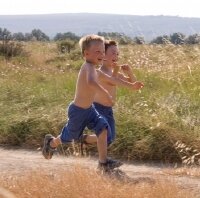 I thought this was core curriculum for every kid. Not so, apparently.
In response to a world suffocated by “screen” time, the Trust compiled a list of 50 things every kid under 11 years of age should do.
This list includes simple outdoor pleasures such as:
- running around in the rain,
- bug hunting,
- snail racing
- flying a kite, etc.
So, … when was the last time you rolled down a hill, climbed a tree, or even played a tag game?
A great article, and one that reminds me not to neglect the simplest pleasures of “being a kid” (no matter how old we are).
My favourite thing to do as a kid? – build cubby huts, and discover rock pools at the beach…
Click HERE, to tell me your favourite outdoor activity when you were 11 years old …
Tumblewing Glider
Guaranteed to engage your group, and keep them busy for ages.
At A Glance
Using a sheet of large cardboard to produce an updraft, an individual attempts to keep a lightweight paper-plane aloft for as long as possible.
What You Need
- Tumblewing template (click here for pdf)
- Telephone book paper
- Scissors
- Large sheet of cardboard – the bigger the better!
What To Do
Check out this video for a great example of what you’re aiming for.
Intrigued? I was hooked immediately.
To solve this mystery, you’ll need to download the Tumblewing template from the ABC Science website by clicking here. This excellent online resource tells you everything you need to know to get flying within minutes.
One suggestion – try printing the template directly onto telephone book paper (using your printer) to save time / hassle.
As described by the ABC Surfing Scientist, … “Tumblewing gliders are one of the most enchanting and curious paper flying contraptions ever conceived. They are simple to make, easy to fly and cost absolutely nothing. Constructed from lightweight telephone directory paper, they can be kept aloft almost indefinitely and tumble along on the updraft of air generated by a large sheet of cardboard (the paddle). In very still air and with a little practice, they can be steered in any direction, tumbling along at eyelevel just in front of the ‘pilot’…”
From my limited experience, the best flights are achieved in a large, still room (eg school hall or gymnasium). No good outside, or in drafty / heavily air-conditioned spaces. Even the movement of others close by can cause a tumblewing to crash and burn!
People – kids and adults alike – are mesmerised by this simple little glider. Have fun as a pilot, conduct competitions for longest flights, etc.
Variations
- Take a look at the Walkalong Airplane – this blows my mind! Click here to view a video of Phil Rossoni who is generally regarded to have popularised this amazing levitation experience.
Want to make a comment? Please let me and the world know by clicking here…
Thanks to Rich Klajnscek (Gloucester, MA) who passed this little gem onto me.
Simon Says Stretch
A golden oldie enhanced with several great variations.
At A Glance
Participants attempt to strictly follow a series of physical instructions on your command, or be eliminated.
 What You Need
- Flat, open space.
What To Do
Ask your group to stand directly in front of you, in a circle, in lines, or distributed evenly throughout an area, where every person has ample space to move.
Explain that your name is ‘Simon’ and you are the leader, which means that everything you command must be followed – exactly!
However, the trick is, only those commands that are prefaced with the words “Simon Says…” should be obeyed.
Start by announcing that you will only ever command the following moves: Left Arm UP, Left Arm DOWN, Right Arm UP and Right Arm DOWN. Or, Both Arms UP or Both Arms DOWN.
As with all commands, I recommend that you add a matching movement to your command (or not!).
Explain that once the game starts, if anyone initiates or completes a move without the command “Simon Says…” – or performs the wrong move – they simply add a point to their total. Or, you could simply eliminate them, but aiming to score the least number of points is much more fun!
To build suspense, issue a series of “Simon Says…” commands one after the other, and then quickly follow up with an instruction sans the “Simon Says…” piece.
Variations
- As above, but substitute your commands with any series of fun movements and stretches, such as Jumping Jacks, Sit Ups, Attention, etc.
- Introduce a championship round in which you add the command “Simon Says … Clap Your Hands Once (Twice, etc).”
- Click here for latest fun “Simon Says…” variations.
Do you know a fun variation? Please add a quick comment by clicking here…
Bang, You’re Dead!
A lateral thinking exercise which underscores that “truth is obvious to those who know it.”
At A Glance
The leader points to one person sitting among many others in a group and says “Bang, you’re dead.” The group must then identify who has actually been eliminated and how this occured.
 What You Need
- A comfortable, open space
- Minimum of 8 people
- 5 – 15 minutes
What To Do
This is one of those classic “what’s the key?” exercises in which the leader subtly does something while distracting their group with something else, with a view that over time, the group will gradually catch on.
I suggest you start by sitting roughly in a circle (but it’s not critical), and then point your finger to anyone in the group and say “BANG, you’re dead!”
Extra style points are awarded if you elongate the words as you wag your finger about aimlessly, such as “BANG, yooooouuuurr…”, then sharply focus your finger on one person with a rousing “… dead!”
After some moments have passed, ask your group to nominate who it is you unceremoniously eliminated. As you may have guessed, it has nothing to do with who is pointed at – the key I often use is that the deceased will always be the first person to speak after you have said the word “dead.” So, listen carefully.
To this end, it’s a good idea to allow some time to elapse (and therefore provide a space for a number of people to speak up – they always do) before you reveal who it is you took out.
Variations
- For those working in a zero-tolerance environment, substitute the leader’s words with “Surprise” or any other useful sounding word(s).
- Rather than point, sit with your legs crossed (or uncrossed), making sure that your right (or left) foot is pointing to a particular individual (the dead person). So for each round, you adjust your sitting (foot) position, say the magic words, and then sift through the various guesses until the deceased is identified correctly.
- As in all ‘what’s the key?’ variations, invite those members of the group who think they have it, to have a go.
Adapted from ‘What’s The Key?’ taken from ‘No Props: Great Games with No Equipment.’
If you know of a cool variation to this exercise, please add a comment…
A New Wordle
If you’ve been to one of my workshops, you’ll know that I love puzzles, and one of my favourites is Wordles - you know, those absorbing cryptic word puzzles that come with a hidden word or phrase. Such as:
R | E | A | D | I | N | G
… which is the wordle for Reading Between The Lines.
These fun brain-teasers are ideal for inspiring creative thinking, not to mention, filling in a few idle minutes. Or, do as I do, present them while you’re waiting for people to turn up – it’s a great way to keep people busy and interacting.
Here’s one that stumped me recently, which hard core Wordle lovers may also find challenging:
CY CY
Hover your cursor here for the answer, but only after you’ve thunk for a while!
If you love these clever little puzzles, take a look at ‘Count Me In’ in which you’ll find dozens and dozens of them at the back of the book.
Do you know any new Wordles to share? If so, please leave a comment here…
Sticky Beak
Filed under: De-inhibitizers, FUNN Games, Ice-Breakers
A quick elimination exercise that is totally FUNN
At A Glance
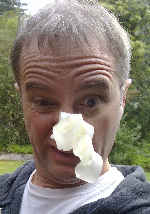
With a small roll of masking tape sitting on the end of their noses, individuals attempt to ‘steal’ other people’s tape by gently pushing against the latter’s nose.
What You Need
- Roll of masking tape
What To Do
Just had to share with you this really simple, but totally hilarious activity I tried out for the first time last week with a group of students…
To save time, prepare a bunch of pre-cut/torn pieces of masking tape in advance, one piece for each person in your group. Cut each piece to approx 10cm in length.
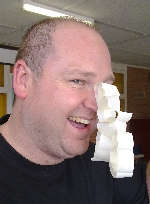 Ask each person in your group to grab a piece and then roll it into a circle where the two ends meet, whereby the sticky side is facing out. Then, invite each person to place this sticky apparatus onto the very end of their nose. For longer staying power and strength, people may clamp down the tape (using the inside of the sticky tube) onto their nose.
Finally, on “GO,” invite each person to engage with another, face off, and move gently towards the other in an attempt to have their sticky beak touch their partner’s sticky beak, then quickly pull back. In 9 out of 10 cases, one person will lose the tape from their nose, because it now sticks precariously to the end of their partner’s taped nose.
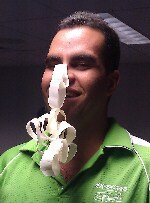 The game continues with those who still posses a sticky beak attempting to eliminate all other competitors, until at last, one person remains – the winner! Keep your camera handy, because (evidently) the elongated masking-taped nose of the winner is worth a shot.
To get a sense of what you could end up with (thanks to Daryl, David, and er, .. me), I’ve added a couple of photos!
PS: It’s OK for people to occasionally tamp down on their original masking tape circle, to help it to remain stuck to one’s nose. But… mashing all of the accumulated tapes into one big sticky mess is not kosher!
 Variations
This is still new to me, but… do you know of any variations? If so, please share in the comments…
One Duck
Another one in a long line of hilarious it-should-be-so-easy-to-do activities.
At A Glance
Sitting in a circle, each person recites one part of a four-part phrase which multiplies each time it is completed, until the group has recited each part five times in a row without mistake.
What You Need
- A comfortable, open space possibly with chairs.
- Minimum of 8 and up to 15 people.
- 10 – 15 minutes
What To Do
Form your group into a circle and ask the participants to repeat the words “One duck – fell in – the pond – kerplunk”. The punctuation is deliberate, and should be reflected in the way you recite the verse the first time, ie it goes something like this “one duck” (pause) “fell in” (pause) “the pond” (pause) “kerplunk”. Consider it a stanza comprising four parts.
Instruct the group that you would now like them to repeat this verse – one person at a time in a clockwise direction – saying only one part at a time. For example, the first person will say “One duck”, and the person to his / her left will then say “fell in”, and so on.
Now for the tricky bit. When you get to “kerplunk”, the verse is repeated again, but this time, each part of the stanza is said twice. So, the next person (ie fifth person in turn) says “One duck”, followed by their neighbour repeating “One duck”, then passing to the next person who says “fell in”, and the next repeats “fell in”, etc, etc. Keep going, until you get to the “kerplunk” and “kerplunk” parts.
No prizes for guessing what happens next (I told you this was easy). The verse continues around the circle, this time with each part being repeated three times, then four times, and to achieve the all-time world’s record, a climactic fifth time!! One duck, one duck, one duck, one duck, one duck, fell in, fell in, fell in, and so on and on it goes. If your group can make it to this level, you all deserve a huge round of applause, or a long lie down!
Explosions of incredulous laughter will break out when someone, typically, forgets how many of which part of the verse has already been uttered. It seems so easy to count to five, yet after many failed world record attempts, I totally understand why the record is so elusive. Give it a go.
Variations
- Have the verse circle the group in the opposite direction.
- Make up your own little verse, with perhaps five, six or even seven parts. Arghhhh…..
Taken from ‘No Props: Great Games with No Equipment’
If you know of a cool variation to this activity, please add a comment…
Mintie Game
An awesome mixer that is as effective as it is delicious
At A Glance
Starting with 10 treats each, people aim to earn more treats by causing as many people as possible to say the word “YES” in their ensuing conversations.
What You Need
- 10 ‘Minties’ or other sweet treats (preferably wrapped), per person
- 5 – 10 mins
What To Do
Ohhhh, this seems so easy to do, but I swear the simple exercise of not saying “YES” is so hard.
I first played this game with ‘Minties’ (refreshingly chewy mint lolly), but it works just as well with any sweet treat. Distribute an exact number, say 10, to everyone in your group, and then just as quickly, tell them not to eat them – just yet!
Now, invite your group to mix and mingle with each other, engaging in conversation as often as possible. Encourage them to introduce themselves, exchange pleasantries etc, etc, and then engage in the fine art of conversation. But this is not just any form of conversation; your goal is to cause the other to say the word “YES.” Every time your partner utters this pleasantly uncomplicated word, you gain a Mintie. The person with the most Minties at the end ‘wins.’
My favourite line to gain a quick Mintie? I spy anyone on their own, approach them and calmly ask “Do you have any Minties left? “Yes I do, er…arghhhhhh..” Works like a charm.
Variation
- Substitute the word “YES” with other colloquially popular words such as “LIKE,” and if you want to make it really difficult – the word “AND.” It’s near impossible!
Taken from ‘Count Me In: Large Group Activities That Work!
If you know of a cool variation to this activity, please add a comment…
Count Off
Looking for a fun two-minute filler – this is it.
At A Glance
A group attempts to count from 1 to 20 in one shot, where people at random say one number at a time, without establishing a pattern or speaking over another person.
What You Need
- A comfortable, open space.
- Minimum of 5 people.
- 2 – 5 minutes.
What To Do
Invite your group to get comfortable wherever they are, and explain that you would like them to count to twenty. Sounds simple enough, but there are a few catches.
In an effort to count from one to twenty, an individual can only call out one number at a time, ie they can’t call out two numbers in succession, but they can call another number later. Also, any time one or more people call out a number at the same time, the count goes back to zero. The biggest catch is that the group is not permitted to establish a pattern, nor is anyone allowed to indicate / gesture / motion to another that they should call the next number. The sequence of calls is purely determined by chance. That’s what makes this game so contagiously fun.
The glee that strikes a group when two (or more) people speak at the same time after a long silence is what the game is all about. Within a few minutes, you group may not have reached twenty, but some spontaneous fun was had, and you successfully filled in a few moments.
Variations
- Ask your group to close their eyes during the activity.
- Choose any list to recite, such as the alphabet, the chemical tables, months of the year, and numbers of seven (eg 7, 14, 17, 21, 27, 28, etc).
Taken from ‘No Props: Great Games with No Equipment’
If you know of a cool variation to this exercise, please add a comment…
-
Who am I?

Hi, I'm Mark Collard.
This blog shares some of the most successful group games, team-building activities & programming tips I know.
--| FREE ACTIVITY eBOOK |--

Enter your name and email address in the form below to receive a FREE 30 page ebook which features ten of the BEST ice-breakers & group games I know!
Share: Tell others about this site...

@markcollard