
Me You You Me
(You’ll note a few NEW features in this activity write-up,
just a precursor to what’s in store in my new online activity resource
www.playmeo.com – launching July 2012).
At A Glance
Walking inside the perimeter of a circle, each person introduces his or her name and repeats the name of every other person they are greeting in a particular sequence.
Benefits
A know-your-own-name-game classic in the making
- Triggers spontaneous laughter
-
 Highly interactive
- Deceptively simple
What You Need
- 5 minutes
- Nil equipment
- Recommend 10 – 20 people
What To Do
Start by asking your group to form a circle. Using your example as a demonstration, step in front of the person who was standing to your left. Shake this person’s hand, and simply say your own name. Nothing else, no “How do you do,” or “My name is…,” simply state your name. Next, whilst still shaking hands, instruct your partner to say his or her name. Pretty easy so far, but it’s not over. Here comes the fun part.
The person who first introduced him or her self (you in the case of this demonstration), now repeats (says) the name of the person they are greeting (you’re still shaking hands by the way). Again, nothing more, just repeat their name. And, to finish, your partner repeats (says) your name back to you.
That’s it, you can now unclasp sweaty hands, and move on to the next person to your right in the circle. So, if I were starting, and the name of my left-hand side neighbour was Ruby, our exchange would sound like this – “MARK,” “RUBY,” “RUBY,” “MARK.”
This exact process of back-and-forth greetings continues with each greeter (you, initially) moving to his or her right, and shaking the hands of the next person in the circle. And, as they do, this movement causes the outside of the circle (which has just been greeted) to follow behind the first person (you) effectively curling inside itself. For example, by the time you get to the third person in the circle, the first person you greeted will have joined you inside the circle and started to greet the second person in line. Get it?
In essence, everyone gets to walk on the inside of the circle and greet everyone once, and then resume their original position in the circle. At which point, every other person will greet them a second time as these folks step inside the circle and return to their original spot in the circle.
Trust me, this really is very simple, it’s just not very easy to comprehend when you are only readings words off a page. And I can almost guarantee, inside the time it takes for the first few exchanges to occur, the group will erupt in guffaws as one or more people mix up their names. It’s astonishing how often people say the wrong name at the wrong time.
Leadership Tips
You’d be mistaken to think that this exercise was all about learning names. Yes, some folks may pick up a few names, but it’s all about taking subtle risks, sharing and above all, laughing.
With especially large groups (see variation described below), as the two tails of the inner circle meet and start to pass each other, one of two events may occur – (a) the action stops because no one knows how to deal with the chaos, or (b) the group will battle on trying to successfully greet everyone per the rules. Either way, it doesn’t matter, provided you generated lots of non-threatening interaction and laughter.
Variations
- Got a large group of say 30 or 50 people? Two options (a) you can split this number into several smaller groups (and continue as above), or (b) if you would prefer to keep them all together, start the initial greetings to the left and right direction of the break in the circle at the same time. That is, you get one ‘snake’ started off to your left, and then after a few exchanges, leave the head of that snake and start a new one on the right hand side of the circle from whence you were standing. The two snakes will eventually meet in the middle and collide, and chaos will reign. But that’s OK, some groups will persist to make it work, others will just look to you and say “HELP!” Just smile.
- Exchange the use of a name with something interesting about yourself, eg honest, fun, thirty-two, Brazilian, etc. That was not meant to sound like a personal ad, but you get the idea. So, it may sound like “BUFFED,” “FINNISH,” “FINNISH,” “BUFFED.”
Framing Ideas
How often have you just been introduced to someone new, or that person told you their name, and literally three seconds later, you realise you’ve forgotten their name? It’s as if you never even heard it! Embarrassing, I know! And the truth is, most of us would prefer to avoid that person (for the rest of the party, or work shift, etc) than face the ignominy of fessing up and admitting to have forgotten that person’s name. This exercise says it’s OK to forget someone’s name, and that it’s OK to ask someone to repeat their name to remind you.
Most people are inclined to suggest that they are not very good at remembering people’s names. I don’t think this is true, but most of us would rather lower people’s expectations than face the embarrassment of getting a name wrong. This exercise re-frames this awkward social phenomenon by saying that it’s OK to ask someone to repeat their name, because this interaction says “I care to know your name”, and not that “I’m stupid and forgot.”
Sourced from ‘No Props: Great Games with No Equipment’ and adapted for use in playmeo.
Ubuntu Cards
One of the most exciting NEW props you can use to invite interaction and fun
At A Glance
A set of unique double-sided picture cards which present an endless array of conversation starters and opportunities to interact within a group.
 What You Need
- 1 x set of Ubuntu cards
What To Do
These cards are my latest #1 favourite prop – here’s just one of a zillion of ways to use them…
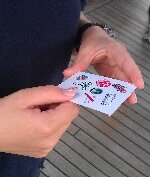
Distribute one card (there’s 54 in the pack) to each person in your group. Describe that that there are two sides to each card, every one of them different.
On one side, there is a large picture of a unique object such as a hammer, a rubber chook or a model train. On the other side, there are 8 smaller images selected from the 54 larger items. Somehow (and I’m not a mathematician) any two cards will have one item in common among these 8 images. Crazy, I know! But it works every time.
Ask everyone to mingle and find a partner. On the count of “1, 2, 3″ each person flashes the 8-image side of their card to their partner. The first person to identify the common image / object, earns a brownie point!
From this point, you can take one of many routes. For example, once the match is identified, ask each partnership to have a quick chat to discover at least one thing that they have in common – but – encourage them to look beyond the obvious. Then, each person swaps Ubuntu cards, and returns to mingling and seeks out a new partner. And repeat many times.
 Variations
- As above, but this time, partners stand back to back. One person starts by describing one of the 8 smaller objects on his/her Ubuntu card – but, without using the object’s name. They can describe its use, colour, shape, where it may be found, etc. Once a match is discovered, partners turn around and continue to share as above.
- Click here to read several more Ubuntu Card variations posted on the official Ubuntu Collaborative Resource page (as moderated by my good friends Ryan McCormick & High-5 Learning Adventure Center, USA).
If you are already using Ubuntu cards, why not post your favourite variation by clicking here…
Click here if you want to get your own Ubuntu card set?
Who! by Karl Rohnke
A name game you can play with a large group.
At A Glance
Standing in the centre of a circle of people, a person points to someone and yells “Who” inviting them to trade places, before the new person repeats the sequence.
What You Need
- 5-10 mins
What To Do
Earlier this month, I visited Boston to be a part of Project Adventure’s 40th Anniversary celebrations. What a blast, especially to mix with the likes of Karl Rohnke and many other awesome PA staff and alumni.
Karl, Nate Folan (PA staffer) and I were invited to share a few games with everyone at the welcoming session, and this was Karl’s opener! Click here to view Clap Trap, another fun activity Karl introduced.
Start by asking your group to form a circle. With you in the centre, point to someone (perhaps, who you don’t know) in the circle and yell loudly ‘Who!” This will invite this person to walk towards you, and as you meet you could shake hands and exchange greetings, perhaps even using one another’s name.
You now move into the circle where the second person was standing, inviting the latter to resume the pointing and greeting routine.
Once it appears that the group has grasped what is going on, randomly introduce a second, third, fourth, etc persons into the centre of the circle to ramp up the energy and participation.
Variation
- For groups that already have a good level of ‘name-knowingness’, try Fill Me In.
Thanks Karl 
If you know of a fun variation to this game, please add a comment here …
Ice-Breaker Exchange
Simple, non-threatening game to get people interacting and sharing.
At A Glance
Starting with a question card each, partners ask each other the question on their card, before swapping cards and then seeking a new partner to ask their new question.
What You Need
- Set of Ice-Breaker Question cards
What To Do
 In advance, prepare a set of ‘ice-breaker’ type questions on a series of index cards – one question per card. There are hundreds of questions you could use, but to save time, click here for a set of 24 great ice-breaker questions ready to print onto index cards. As you develop more questions, make them as open, non-threatening and interesting as possible.
Next, randomly distribute one card per person. Then, ask each person to find a partner who has similar length of hair to them (or any other fun, random way of splitting your group into pairs).
The action starts with each person asking their partner the question on their card. After this person has responded, the partner asks the question on their card. Upon completing this exchange, they swap cards, and then each seek a new partner. Repeat over and over.
Variations
- Form groups of three or more, inviting each person in the group to respond to each question, before swapping cardsd and forming a new group.
- For more energetic groups, replace the questions with actions. For example, ‘Perform ten star-jumps in a row,’ ‘Shake the hand of five different people within 30 seconds,’ and ‘Run around the outside of the group as quickly as possible.’
If you know of a fun variation to this game, please add a comment here …
One Car – Two Siblings
** [note - if you've got a better name for this activity, please leave a comment here] **
Sitting in a train on my way to open a conference this week, looking for a novel opener, I came up with this fantastic idea (a twist to the wonderfully successful Commonalities) … and it worked a treat, so I wanted to share it with you.
It’s always tough to ‘break the ice’ when people are seated in rows, or in a lecture theatre, or round a table – hard to move people about. And this is exactly what I had to work with. Here’s what I did…
I asked people to partner up with one or two other people sitting close to them. After quick introductions are exchanged, I invited each group to have a conversation in which they sought out all the “things” they (all) had in common … but with one proviso. Starting at one, and moving through the numbers as high as they could go within three minutes, their object was to find that number of things / objects / experiences they had in common. As this explanation was met with a few blank faces, an illustration followed.
For example, starting at one, the group may discover that they all own ONE car. Then they might discover they all have TWO siblings. Moving on, they have all taken THREE overseas holidays, and all have FOUR letters in their first names, and so on.
On this particular morning, one group of three people got as high as EIGHT – apparently, they all had the numeral eight in their street address (which, maybe, is stretching the framework of the game – but who cares – they were talking and interacting and, best of all, along with 100 other people, were laughing and generating TONS of energy….)
… and voila – a new ice-breaker!
Try it out, and tell me what you think …
Commonalities
A fun way to get to know others in your group
At A Glance
Small groups develop a long list of things they have in common with each other, and then share them with the larger group to earn points for each unique attribute.
What You Need
- Pen and paper for each small group
What To Do
 This is one of those activities that somehow fell off the radar, and now, having just used it for the first time in 10 years, I’m all excited about it again.
Ask your group to divide into groups of 4 to 6 people – the size is not too critical, but any larger than 6 and the search for commonalities becomes more difficult.
Equip each group with a pen and paper, and then invite them to develop a list of attributes / things that everyone in their group has in common. Five minutes thinking time is normally long enough.
For example, after a quick discussion, a group may discover that they are all the eldest in their families, or they have all visited the Melbourne Zoo, or perhaps can sing the first line of a Beatles song. Whatever – “it” just has to be common to everyone in the group, and the group with the longest list of commonalities wins!
Now, at this point, some groups get a little too excited thinking that, given it’s a competition, they just list all of the really obvious things they have in common, such as “we’re all wearing clothes,” “we all have teeth,” “we all have mothers,” etc. Groups are welcome to add these very obvious attributes to their list, BUT…. (here’s the kicker), if at least one other group has the same attribute on their list, both groups must cross it off their tally.
Yep, not so easy anymore, and – purposefully – this rule encourages groups to look for the really interesting things they have in common. Such as “driven more than a kilometre with the hand-brake on” “all born by caesarean” and “been in an ambulance,” as just three worthy contenders I’ve actually heard.
Have FUNN…
Variations
- Do the opposite – ask your group to develop a list of things that no one has in common (altogether much more difficult) – that is, you are looking for “things” that only one person can lay claim to, eg “been struck by lightning,” “rolled an ambulance” and “never broken a bone.”
- Drop the “duplicate” rule, and inspire each small group to develop a really long list of things they have in common, allowing as many obvious attributes as possible. More a competition of quick thinking than creativity, perhaps.
Mintie Game
An awesome mixer that is as effective as it is delicious
At A Glance
Starting with 10 treats each, people aim to earn more treats by causing as many people as possible to say the word “YES” in their ensuing conversations.
What You Need
- 10 ‘Minties’ or other sweet treats (preferably wrapped), per person
- 5 – 10 mins
What To Do
Ohhhh, this seems so easy to do, but I swear the simple exercise of not saying “YES” is so hard.
I first played this game with ‘Minties’ (refreshingly chewy mint lolly), but it works just as well with any sweet treat. Distribute an exact number, say 10, to everyone in your group, and then just as quickly, tell them not to eat them – just yet!
Now, invite your group to mix and mingle with each other, engaging in conversation as often as possible. Encourage them to introduce themselves, exchange pleasantries etc, etc, and then engage in the fine art of conversation. But this is not just any form of conversation; your goal is to cause the other to say the word “YES.” Every time your partner utters this pleasantly uncomplicated word, you gain a Mintie. The person with the most Minties at the end ‘wins.’
My favourite line to gain a quick Mintie? I spy anyone on their own, approach them and calmly ask “Do you have any Minties left? “Yes I do, er…arghhhhhh..” Works like a charm.
Variation
- Substitute the word “YES” with other colloquially popular words such as “LIKE,” and if you want to make it really difficult – the word “AND.” It’s near impossible!
Taken from ‘Count Me In: Large Group Activities That Work!
If you know of a cool variation to this activity, please add a comment…
Let Me Introduce
An exercise where you introduce everyone else but yourself
At A Glance
Each person approaches as many people as possible within a specified time limit, introducing each of them to another person in the group.
What You Need
- 2 – 5 mins
What To Do
I’ve found this simple re-working of the traditional form of introductions a brilliant way to rid my group of a lot of that tension that most people experience when they first get together. It won’t evaporate all of the awkward feelings, but it is fun and is guaranteed to create a ton of energy.
With your group milling about, ask them to casually approach any other person in the group – whether they know their name or not – greet them, and ask for their name. Embodied with a lively demonstration, it will sound something like this. “Hi, what’s your name?” The doe-eyed person you have just approached says “Simon,” and you reply with “Hi Simon, come with me, I’d like to you to meet somebody.” At which point you lead Simon with you over to another unsuspecting group member, and say “Hi, what’s your name?” and it might be Vijay this time. “Hi Vijay. I’d like you to meet Simon. Simon this is Vijay.”
Having done the job of the Introducer, explain that each person now moves on to either seek a new person to greet, or submit to another person’s invitation to be part of their introduction, and so on. Get the idea?
In principle, the person arranging the introductions need not say their name, but we are so accustomed to doing so in our culture, it often happens anyway!
To give the exercise a little vivacity, announce that your group has three (or whatever) minutes to introduce everyone to everybody else. Won’t happen, but that’s not the point.
Variation
- Following on from the basic set-up, one of the two people who have just been introduced to each other, now leads the other to a new person. For example, Simon leads Vijay over to meet and greet with Rachel.
Taken from ‘Count Me In: Large Group Activities That Work’
If you know of a cool variation to this exercise, please add a comment …
Categories
The perfect ice-breaker – ideal for mixing people in a fun and non-threatening manner
At A Glance
Your group splits into a variety of smaller groupings, according to a series of categories you announce.
What You Need
- 10 – 20 mins
What To Do
Ask your group to separate according to the categories or groupings you are about to announce. For example, if the category is “Colour of your pants,” everyone wearing blue jeans will group together. Sometimes, individuals may find themselves alone, but in most cases, small groupings of commonality will develop. Upon identifying each of the groups, announce the next split. You can keep splitting folks for as long as they are having fun, or you run out of ideas.
For mixing purposes, alternate between two-group splits and multi-group splits. The idea is to invite your group to meet as many new people as possible. To this end, if you have the time and the inclination, as soon as the groups have formed, give the participants a few moments to say hello to one another, or perhaps share something of relevance to the category, e.g., “What was so cool about being the oldest / youngest / in-between child in your family?”
Here are just a few sample and fun group categories. There are simply hundreds of them out there, so please, don’t hesitate to make up your own, or tempt them from your group.
Simple half-half splits:
- Arm that ends up crossed over the top of the other, when folded on your chest.
- Leg you put into your pants, shorts, underwear, etc. first when dressing.
- Preference for cooking or cleaning up.
- Preference for washing or drying dishes.
- Position of your thumbs, that is left or right on top, when you clasp your hands together so that your fingers interlock.
- Last digit of your home telephone number. All the odd numbers – 1, 3, 5, 7 or 9 – get together, and the even numbers do the same.
- When presented with a ‘good news / bad news story,’ which do you prefer to hear first?
- Preference for the way toilet paper spills off the roll – like a waterfall, over the top and forward, or against the back towards the wall.
- Number of street you live at – odds and evens.
Simple multi-group splits:
- Month / zodiac sign in which you were born.
- Number of continents you have visited.
- Number of siblings in your family, including yourself.
- Colour of your eyes, hair, socks, etc.
- Type of shoes you are wearing (not necessarily their brand).
- Which shoulder(s) you hold a carry-bag – right, left or both shoulders.
- How often you shave each week?
- Distance you have travelled to get here (use clumps of distances, such as 0-5 km, 5-10 km, etc.
- Number of items you recycle at home, e.g., plastic, glass, tin, paper, etc.
Variation
Use to divide a large group into roughly random and even teams. If you are looking for an even split, and just don’t seem to find a category that fits, simply use the old scientific method of indiscriminately moving a few people (“Hey, you and you, move over here.”) to even out the groupings.
Taken from ‘Count Me In: Large Group Activities That Work’
If you know of a cool variation to this exercise, please add a comment…
Cocktail Party
A quick name reinforcer, and welcome segue to a drink’s break.
At A Glance
People mingle about shaking hands and greeting people by name as quickly as possible.
What You Need
- A flat, open space for mingling.
- As many party-goers as you can muster.
- 2 minutes.
What To Do
Looking for a quick way to wrap up a session, perhaps reinforce a few names people may have just learned, and throw to a drinks break? This is it.
Invite people to bunch around you, capturing the image of palatial surroundings, evening gowns, black ties and cocktails. Suggest that each person holds in their left hand an imaginary drink, or cocktail if they choose. Then, on your signal, everyone is encouraged to meet, shake the hands of and greet as many people at the party as possible, in say, 43.5 seconds (this is not a magic number!).
On “go”, it will sound something like, “Oooohh, darling, so good to see you Peter. I’m having a frightfully good time…..”. Chat for a few moments, discuss drinks, recent holidays to the Swiss alps, and then in typical cocktail party fashion, interrupt the conversation with a “O, petal, must keep moving”. Air kiss, kiss (these are not mandatory), and “…bye bye” off you go to greet another party guest.
Suggest to your group that they should use the other person’s name as often as possible, enquire about the other person’s drink (remember, they are holding on to it), but not spend too long with any one person. For a bit of fun, ask someone for the time and see if they spill their drink!
When you feel like the heat has started to dissipate from the party, quell the action and ask your group what is odd about this activity. Someone usually will remark that “there is no drink in their hands”, which is your cue to say….let’s remedy that situation – time for a break.
Variations
Imagine you are in a swanky Food Hall. Invite people to mingle as they treat themselves to the extraordinary array of fine foods available on people’s trays.
Taken from ‘No Props: Great Games with No Equipment’
If you know of a cool variation to this exercise, please add a comment…
Fill Me In
A name reminder game featuring a chaotic combination of movements.
At A Glance
People assume the place of a person standing in the circle whose name they have just called.
What You Need
- A flat, open space.
- Minimum of 10, and up to 30, more if your group has a good level of name-knowingness.
- 10 – 15 minutes.
What To Do
Having formed a circle, the action begins when one person steps into the circle – at the same time announcing the name of someone who is on the other side of the circle to them – and walks toward that person. The first person fills the space of the newly announced person as this second person moves into the centre of the circle and immediately calls out a third person’s name, and the process starts all over again.
In and out, in and out it goes on. At a point you believe the group is ready for more, introduce a second and third person calling out a name across the circle. A series of chaotic and confusing crossings will result. At this time, encourage lots of eye contact and careful movements.
Variations
- Invite the person who has called out a name, to introduce themselves by name to the other, perhaps shake hands, before this other person repeats the process.
- As the movement of people in the centre of the circle gains momentum, invite people to shake the hand and greet (using the name) of someone as they pass them in the middle of the circle.
Taken from ‘No Props: Great Games with No Equipment’
If you know of a cool variation to this exercise, please add a comment…
-
Who am I?

Hi, I'm Mark Collard.
This blog shares some of the most successful group games, team-building activities & programming tips I know.
--| FREE ACTIVITY eBOOK |--

Enter your name and email address in the form below to receive a FREE 30 page ebook which features ten of the BEST ice-breakers & group games I know!
Share: Tell others about this site...

@markcollard