
Space Counting
(You’ll note a few NEW features in this activity write-up,
just a precursor to what’s in store in my new online activity resource
www.playmeo.com – launching July 2012).
At A Glance
With their pointer fingers extended, two people face each other and on “GO” attempt to draw the numbers from one to thirty in the air as quickly as possible.
Benefits
A brilliant partner activity that is fun as much as it is a metaphor for many real-life situations.
- Simple to accomplish
- Generates lots of energy
- Inspires many powerful metaphors
- Lots of adaptations
What You Need
- 10 minutes
- Nil equipment
- Minimum of 2 people.
What To Do
This gem is sourced directly from my friend and mentor, Karl Rohnke, one of the most well-known (and funnest) adventure educators in the world. He ‘discovered’ this activity as he was pedalling on his exercise bike during the cool-down phase of his daily exercise regime. He challenged himself to draw the numbers of the seconds (in the air) as they ticked down from 60 in the closing minute of his morning routine. And from this humble beginning, blossomed a new partner activity…
Start by asking your group to form into pairs. Each partner should face the other and extend one of their pointer fingers in front of them (chest-height) so that the tip of their finger lies within 30cm (12”) of their partner.
From this ready position, the action begins. On “GO,” each person attempts to write the numbers 1 to 30 as quickly as they can in the air in front of them (aka space) using their pointer finger as their writing instrument of choice. The first one to reach 30 wins, and may pump their clenched fist into the air as a sign of competitive superiority.
Invite individuals to swap partners a couple of times, and then introduce a twist.
This time, invite one of the two partners to copy or imitate the movements of the other as they draw their numbers in the air. My suggested framing would sound like this “TRACE THE IDENTICAL PATH OF YOUR PARTNER’S FINGER.” Note, that I did not say “…write the number backwards” even though these are often the words that passed through their grey-matter! So, while one partner is busy writing numbers in the air, the other person is attempting to precisely follow their drawing movements.
Naturally, when one person has completed their task, they swap roles with their tracing partner.
 As you may have guessed, this exercise is not as easy as it sounds. And for this purpose, I would strongly recommend that after several rounds of this and other variations described below, you debrief your group about what they observed during the activity. See below for valuable leadership and framing tips.
Leadership Tips
As with many activities, especially if there is a chance someone is not listening to you (what?), it’s always a good idea to invite a volunteer to join you in a demonstration. This choice also serves a valuable second objective – it invites someone to ‘take a risk’ which is enormously transformative in the life of a group.
Even if only for a good laugh, suggest that the competitive version of this exercise works on an ‘honour’ system. That is, if an individual feels that a particular number they have just drawn is not legible, they are honour-bound to write that number again, … or not.
With the more strenuous / focused variations, I often instruct the pairs to write from 1 to 15 or 20 at the most.
Variations
- As above, but this time the writing partner chooses to draw any ten numbers at random (between 1 and 30), but their partner’s goal is the same – to trace as best as possible the identical path of their partner’s finger. Again, process your group’s experience – Was this easier or harder to focus? Having removed the anticipation (of what number is coming up next), were you more or less successful?
- In pairs, still facing one another, each person uses their idle (non-writing) hand to grab the wrist of their partner’s drawing hand in an attempt to keep the movement of their drawing arm and hand immobile as possible. Regardless of the version, it’s considerably more difficult, right?
Framing Ideas
As with many play and adventure-based activities, I will often introduce this activity via a fun story (such as how Karl discovered this exercise on his bike) or personal experience. And then as the variations unfold, and I take the time to briefly process my group’s observations and interactions, the connections and metaphors to real life become apparent.
The results of this exercise are rich with many meaningful metaphors. You’re bound to discover more of your own, but here’s a few to start with:
- Style – not everyone performs a certain task the same way, but often gets the same result.
- Goal-setting and Focus – when I am solely focused on achieving my goal (tracing the finger of my partner), I am more successful.
- Distinguishing the actual problem – is my task to draw the numbers backwards (the brain-generated thought of ‘what I thought I heard you say’), or am I following your directions (what you actually said).
- Making assumptions – acting or making a decision based on poor information (pre-empting the shape of a particular number, or the next number in sequence).
Adapted from ‘Silver Bullets: 25th Anniversary edition’ by Karl Rohnke.
Spot The Difference
An activity about noticing what’s different about another.
At A Glance
In pairs, partners take turns to alter a set number of things about their appearance, and then invite the other to identify those changes.
 What You Need
- 5 – 10 minutes.
What To Do
Noticing the little things about people can develop trust and a connection with others in a group. This knowledge and a discussion of the impact the little things have on the effectiveness of a group can often move a group forward.
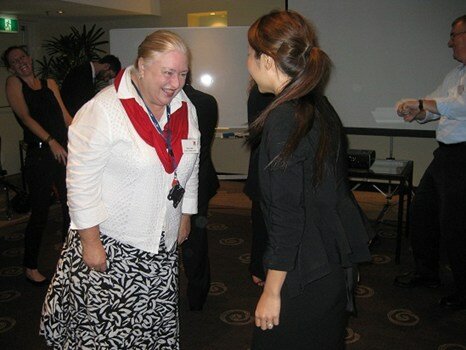
Break your group into pairs, and invite each partnership to stand with their backs to the other. Taking turns, one person will agree to alter three things of their physical appearance, eg roll up their sleeves, swap an earring to the other ear, and untie a shoe-lace. When ready, both partners will turn around and face each other and the “unaltered” person will try to identify every change in their partner’s appearance. They then switch roles. At first, this is a relatively simple task.
Now, without notice, ask each partnership to repeat the exercise, but this time, altering a further three (or whatever number you desire) physical effects of their appearance. The odds are your group will groan as they cry out they can’t think of anything else to change. But that’s a lie, they just haven’t thought about it thoroughly.
For example, note how many people do not think to alter their facial expression, or if they did, how many of their partners were focused on material changes and missed the bigger than usual smile, or frown.
You could go even further and suggest the thoughts of a person could change too. All of these tangible and intangible effects make a big difference to a group’s process – and are often wonderful talking points.
Variation
- As above, but invite groups as large as five or more people to alter X number of things about their appearance, inviting another group to identify the changes. Note, not everybody needs to change something.
Taken from ‘No Props: Great Games with No Equipment’
If you know of a cool variation to this exercise, please add a comment…
.
Train Station Greetings
An hilarious, silly exercise to energise your group.
At A Glance
Two people spy each other on opposite sides of the group and approach one another in ‘slow-motion’ until they are within a metre of each other, and then suddenly they each turn away and look for a new person to start the process over again.
What You Need
- Large group, of say 30+ people
- 5 mins
What To Do
Your sequence and framing of this exercise are very important, so approach with care. If you present when the group is not ready to ‘play’ and act a little silly, it could bomb.
With your group huddled around you (or standing in a circle, doesn’t matter), suggest that you would like everyone to imagine that they are waiting on a train platform in the good old days to meet a long lost friend.
By demonstration, you see them (on the other side of the group to where you are standing) and start waving madly and moving towards them – BUT, in slow-motion. All movements, gestures and sounds are in slo-mo.
By way of a volunteer, ask someone (you have spied) to adopt a similar slo-mo approach to you. Then, suddenly when the two of you are about a metre apart, you discover to your mutual horror that this person is not who you thought it was, and quickly look away.
Eah person then randomly spies a new ‘long lost friend’ (on the other side of the group to them) and they resume the same slo-mo approach toward one another, etc, etc.
Variation
- As above, but perform all of the slo-mo greetings without sounds.
Want to make a comment? Please let me and the world know by clicking here…
Who! by Karl Rohnke
A name game you can play with a large group.
At A Glance
Standing in the centre of a circle of people, a person points to someone and yells “Who” inviting them to trade places, before the new person repeats the sequence.
What You Need
- 5-10 mins
What To Do
Earlier this month, I visited Boston to be a part of Project Adventure’s 40th Anniversary celebrations. What a blast, especially to mix with the likes of Karl Rohnke and many other awesome PA staff and alumni.
Karl, Nate Folan (PA staffer) and I were invited to share a few games with everyone at the welcoming session, and this was Karl’s opener! Click here to view Clap Trap, another fun activity Karl introduced.
Start by asking your group to form a circle. With you in the centre, point to someone (perhaps, who you don’t know) in the circle and yell loudly ‘Who!” This will invite this person to walk towards you, and as you meet you could shake hands and exchange greetings, perhaps even using one another’s name.
You now move into the circle where the second person was standing, inviting the latter to resume the pointing and greeting routine.
Once it appears that the group has grasped what is going on, randomly introduce a second, third, fourth, etc persons into the centre of the circle to ramp up the energy and participation.
Variation
- For groups that already have a good level of ‘name-knowingness’, try Fill Me In.
Thanks Karl 
If you know of a fun variation to this game, please add a comment here …
Commonalities
A fun way to get to know others in your group
At A Glance
Small groups develop a long list of things they have in common with each other, and then share them with the larger group to earn points for each unique attribute.
What You Need
- Pen and paper for each small group
What To Do
 This is one of those activities that somehow fell off the radar, and now, having just used it for the first time in 10 years, I’m all excited about it again.
Ask your group to divide into groups of 4 to 6 people – the size is not too critical, but any larger than 6 and the search for commonalities becomes more difficult.
Equip each group with a pen and paper, and then invite them to develop a list of attributes / things that everyone in their group has in common. Five minutes thinking time is normally long enough.
For example, after a quick discussion, a group may discover that they are all the eldest in their families, or they have all visited the Melbourne Zoo, or perhaps can sing the first line of a Beatles song. Whatever – “it” just has to be common to everyone in the group, and the group with the longest list of commonalities wins!
Now, at this point, some groups get a little too excited thinking that, given it’s a competition, they just list all of the really obvious things they have in common, such as “we’re all wearing clothes,” “we all have teeth,” “we all have mothers,” etc. Groups are welcome to add these very obvious attributes to their list, BUT…. (here’s the kicker), if at least one other group has the same attribute on their list, both groups must cross it off their tally.
Yep, not so easy anymore, and – purposefully – this rule encourages groups to look for the really interesting things they have in common. Such as “driven more than a kilometre with the hand-brake on” “all born by caesarean” and “been in an ambulance,” as just three worthy contenders I’ve actually heard.
Have FUNN…
Variations
- Do the opposite – ask your group to develop a list of things that no one has in common (altogether much more difficult) – that is, you are looking for “things” that only one person can lay claim to, eg “been struck by lightning,” “rolled an ambulance” and “never broken a bone.”
- Drop the “duplicate” rule, and inspire each small group to develop a really long list of things they have in common, allowing as many obvious attributes as possible. More a competition of quick thinking than creativity, perhaps.
Sticky Beak
Filed under: De-inhibitizers, FUNN Games, Ice-Breakers
A quick elimination exercise that is totally FUNN
At A Glance
With a small roll of masking tape sitting on the end of their noses, individuals attempt to ‘steal’ other people’s tape by gently pushing against the latter’s nose.
What You Need
- Roll of masking tape
What To Do
Just had to share with you this really simple, but totally hilarious activity I tried out for the first time last week with a group of students…
To save time, prepare a bunch of pre-cut/torn pieces of masking tape in advance, one piece for each person in your group. Cut each piece to approx 10cm in length.
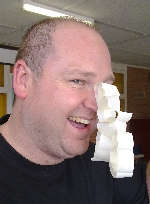 Ask each person in your group to grab a piece and then roll it into a circle where the two ends meet, whereby the sticky side is facing out. Then, invite each person to place this sticky apparatus onto the very end of their nose. For longer staying power and strength, people may clamp down the tape (using the inside of the sticky tube) onto their nose.
Finally, on “GO,” invite each person to engage with another, face off, and move gently towards the other in an attempt to have their sticky beak touch their partner’s sticky beak, then quickly pull back. In 9 out of 10 cases, one person will lose the tape from their nose, because it now sticks precariously to the end of their partner’s taped nose.
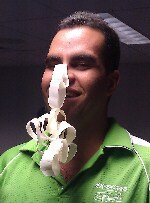 The game continues with those who still posses a sticky beak attempting to eliminate all other competitors, until at last, one person remains – the winner! Keep your camera handy, because (evidently) the elongated masking-taped nose of the winner is worth a shot.
To get a sense of what you could end up with (thanks to Daryl, David, and er, .. me), I’ve added a couple of photos!
PS: It’s OK for people to occasionally tamp down on their original masking tape circle, to help it to remain stuck to one’s nose. But… mashing all of the accumulated tapes into one big sticky mess is not kosher!
 Variations
This is still new to me, but… do you know of any variations? If so, please share in the comments…
Elevator Air
Filed under: De-inhibitizers, Ice-Breakers, Warm-Ups & Stretches
A gentle, yet experiential way to introduce the desired tone of your program.
At A Glance
People cross to the other side of the circle in which they are standing in the manner of various ‘mind-states.’
What You Need
- A flat, open area to accommodate a wide circle.
- Minimum of 10 people.
- 5 – 10 minutes.
What To Do
Everyone knows what it means to be in an elevator. You step in, no one looks at you, you press the button for your floor. Doors close, and you instinctively glance up at the numbers blinking above the doors as if it holds the answer to the meaning of life. Moments pass, and you glance up again and can’t believe that you still have 10 floors to go. You can’t wait to get out… you know how it goes.
Share a little of this with your group, to get them ready for the what’s next. It will often spark a chortle or two, perhaps even a few comments about how dumb this all seems. Which, if this happens, is just perfect, and I recommend you allow it to occur.
Starting with a large circle, invite every person to simply walk to the other side of the circle from where they are standing as if they had just entered an elevator. No talking, barely any eye contact, and certainly no interaction. Take note of what happens, how it feels, etc. This is ‘Elevator Air.’ Ask your group to comment on how it felt for them.
Okay, ask everyone now to return to their original spots in the circle, but this time as if they were entering a room full of people they knew and had not seen in a long time. This is ‘Long Lost Air.’ Again, observe what happens. Without even saying it, I can guarantee they will instinctively go out of their way to interact with one another.
Now, put it to the group, which atmosphere felt the most comfortable? Which atmosphere do you believe would be the most productive? You can probably see where this is heading, right?
Take just a few moments to establish what caused the difference, and to connect this to your program. Typically comments such as “it was safer”, “I felt trusted”, “I knew everyone better”, “I was able to take risks” will be offered. Fantastic! Suggest that this is exactly what you hope to achieve with your program, and importantly, you invite every member of your group to take responsibility for creating this atmosphere right here, right now. You’re ready to move on.
Variations
- If your group needs a little warming up between ‘Elevator’ and ‘Long Lost’ Air, try ‘Highway Air’ – you know, that generally friendly, safe and more curious way we are with others when we are driving our cars as we acknowledge others in the vehicles. But of course, avoid any ‘road rage’ suggestions.
- Add a further (final?) crossing in the manner of walking into a wild party. Discussion can still follow which looks at the impact of “being” this way with people. For some, this will be very positive / fun, but for others, perhaps scary.
Taken and adapted from ‘No Props: Great Games with No Equipment’
If you know of a cool variation to this ice-breaker, please add a comment…
Moon Walking
The closest people can get to flying without wings
At A Glance
Two people holding the lower arms of a third person whose hands are on his or her hips, physically support the latter as he or she jumps into the air.
What You Need
- 2 – 5 mins
What To Do
Use a variety of Clumps, ending with “THREE” to form random groups of three people. Ask one person to place hands on hips (thumbs pointing backwards) and to hold this stance firm. Instruct the two others of this triad to approach the first person, and grab a lower arm each with their two hands, often placing one hand at the wrist and the other just below the elbow.
Upon engaging in this exercise, allow people to choose where is best for them to place their hands. What is important to stress, however, is gentle but firm grips, and that the middle person maintains a solid stance at all times.
Now, commence the countdown, and ask each of the middle people to jump high into the air. At the same time, their partners will lift their colleagues gently into the air giving extra support to allow for a jump which is higher than can normally be expected. Note, I said “gently” and “extra support” – not fling, heave or toss your jumper into the air!
Depending on your sequence, this could be one of the first occasions in which you have introduced some form of exhilarating physical rush for your participants. It will often elicit much applause and screams (of joy). Apart from the obvious merriment of jumping really high, this is also an excellent activity to introduce your group to the concept of taking care of others – which, in turn, contributes to building a feeling of trust, support and community.
Hence, your sequencing must be spot on. Do not introduce this exercise to your group unless they have already exhibited healthy levels of safety consciousness in your lead-up activities.
Variation
- Same set-up as above, but this time, invite the threesome to move forward five paces, stepping forward in rapid succession with each jump. It will almost feel like flying.
Taken from ‘Count Me In: Large Group Activities That Work’
If you know of a cool variation to this activity, please add a comment…
Mirror Image
Filed under: De-inhibitizers, Warm-Ups & Stretches
Excellent for stimulating mutual co-operation and plenty of unself-conscious stretching.
At A Glance
Facing each other, one person will reproduce the “mirror image” of the moves of their partner.
What You Need
- A flat, open space.
- Minimum of 2 people.
- 5 minutes.
What To Do
Ask people to find a partner who is about their height, and gather around. Start with a demonstration, inviting a volunteer to face you standing about half a metre apart. You initiate the action while the other person becomes your “mirror image”. Get that, it’s a mirror image, so if I extend my left arm out to my left-side, my partner will extend their right arm out to their right-side.
The intention is to make your movements interesting and slow enough for the other person to mime as if they were a full-length mirror. The enjoyment level is definitely enhanced by an initial zany presentation of unself-conscious stretching. Try not to succumb to typical “star jump” types of stretches – rather, for example, invent an innovative and fun morning “wake up” routine that includes having a shower, dressing in stretchy trousers and a long-sleeve angora sweater, etc.
Got a few laughs, it’s now time to turn it over to the group. The facial and physical gymnastics that result lets you see people like you’ve never seen them before. Swap roles after an appropriate time.
Variations
- After each partner has had their turn, ask them to try the anti-mirror (or reverse) image – during which the follower tries to mime exactly the opposite of their partner’s movement. Classic moves and total confusion are sure to follow.
- Repeat in groups of three or four people (all but one are the mirrors), but not too many more lest people get a little self-conscious.
Taken from ‘No Props: Great Games with No Equipment’
If you know of a cool variation to this stretch, please add a comment…
Pairs Compass Walk
Filed under: De-inhibitizers, Problem-Solving, Trust Exercises
Marvel at people’s amazing ability to completely lose their sense of direction.
At A Glance
A blind-folded person attempts to walk directly in a straight line towards a target about 50 metres away.
What You Need
- A wide, open but not necessarily flat space.
- Minimum of 2 people.
- 10 – 20 minutes.
What To Do
Ask your group to divide into pairs. To start, one person identifies a distant object from across the space – a tree, a rock, a door, etc – and announces the object to their partner. With their eyes completely closed (no peeking) they begin to move directly towards it. Their aim is to walk “straight” to the object, in pursuit of the lofty ideals of accurate distance and direction.
To ensure a safe arrival, the sighted partner follows the blinded silently from behind. They can not verbally or physically assist their partner, rather their role is to prevent them from encountering any “unplanned” obstacles by stopping them just short of a collision, ie they are a spotter.. To this end, it may seem to make more sense to protect one’s partner from the front or side, but in my experience, this practice tends to crookedly influence the blind person’s direction and is therefore not recommended.
This activity works best if the targets are at least 50 – 100 metres away. Instruct the “spotters” to observe and note the tendency for their partners to veer either left or right, and to what extent. The looks on people’s faces when they discover how far off they were from their target is worth bottling. Full circles are not uncommon.
Follow-up with a good-natured discussion about what helped and hindered the process of travelling to the target and the consequential development of trust. A typical result – if your compass says to go one way, and your gut feeling strongly suggests another, trust the compass!
Variations
- Ask two people (possibly with opposite biases) to walk hand in hand. In this case, their original partners will walk directly behind these two co-joined people and note and ensure their safe progress.
- See Group Compass Walk (No Props p149), where you bring your entire group together in an attempt to walk as a group “blind-folded” towards a common object.
Taken from ‘No Props: Great Games with No Equipment’
If you know of a cool variation to this activity, please add a comment…
Fill Me In
A name reminder game featuring a chaotic combination of movements.
At A Glance
People assume the place of a person standing in the circle whose name they have just called.
What You Need
- A flat, open space.
- Minimum of 10, and up to 30, more if your group has a good level of name-knowingness.
- 10 – 15 minutes.
What To Do
Having formed a circle, the action begins when one person steps into the circle – at the same time announcing the name of someone who is on the other side of the circle to them – and walks toward that person. The first person fills the space of the newly announced person as this second person moves into the centre of the circle and immediately calls out a third person’s name, and the process starts all over again.
In and out, in and out it goes on. At a point you believe the group is ready for more, introduce a second and third person calling out a name across the circle. A series of chaotic and confusing crossings will result. At this time, encourage lots of eye contact and careful movements.
Variations
- Invite the person who has called out a name, to introduce themselves by name to the other, perhaps shake hands, before this other person repeats the process.
- As the movement of people in the centre of the circle gains momentum, invite people to shake the hand and greet (using the name) of someone as they pass them in the middle of the circle.
Taken from ‘No Props: Great Games with No Equipment’
If you know of a cool variation to this exercise, please add a comment…
-
Who am I?

Hi, I'm Mark Collard.
This blog shares some of the most successful group games, team-building activities & programming tips I know.
--| FREE ACTIVITY eBOOK |--

Enter your name and email address in the form below to receive a FREE 30 page ebook which features ten of the BEST ice-breakers & group games I know!
Share: Tell others about this site...

@markcollard