
The Maze
Dynamic problem-solving initiative that can be linked powerfully to real life
At A Glance
A group attempts to navigate the correct path across a series of spots on the ground.
 What You Need
- Bunch of rubber spots / carpet tiles / chalk circles
- Pen & paper
What To Do
This is an ideal probelm-solving exericsewhen you don’t have a lot of room to use.
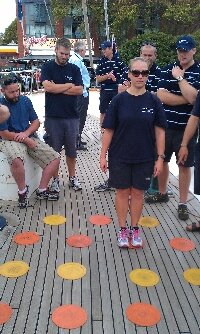
In advance, lay a series of rubber gym spots /carpet tiles or simply draw chalk circles on the floor, arranged in rows and columns (see photograph). There’s no magic number, but the more spots, the more difficult the task will be.
Start your group at one end of the spots, and explain that you would like the group to navigate their way through the maze – one step at a time – to identify the secret pathway. The correct path starts with one of the spots in the top row (closest to the group ), and will finish with one of the spots which form the final row. How the path travels between those two points is a secret.
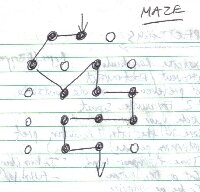
As with electricity, suggest that the secret pathway will follow the path of least resistance, so it will not run in a straight line, and may turn in any direction, but it will never cross itself, nor use any spot twice (see sample below). Also explain that once identified, the path will not change.
Instruct your group that only one person is entitled to enter the area of the spots at any point in time. To this end, the group may choose to task several people to enter the area to navigate the path, but only ever one person at a time. Explain that every time a spot is stepped on (with both feet), you will either give the thumbs up (yes, part of the path) or thumbs down (no, not the correct path). Tally the number of “errors,” challenging the group to navigate the path with as few errors as possible.
This is the basic set-up. To add extra spice, add one or more of the variations described below.
Note, like many problem-solving activities, this activity and its execution are wonderfully applicable to many a metaphor. For example, the maze represents a journey (or the life of a group), because it has a start and an end and many unknowns in between, and to be successful the whole group must work together, etc.
Variations
-
 Each time an error is made (stepped on wrong spot, or perhaps in wrong sequence), require the stepper to retrace their correct steps back out of the maze returning to the start.
- Establish a maximum number of “errors” the group can incur to be “successful.” Based on the maze I often use ( illustrated at right), most groups are able to be “successful” in 30 or less errors.
- Ask the group to complete the task silently, ie no verbal communication once the spotted area is entered for the first time. This may mean that they group can talk during their designated planning time.
- For groups still developing their social skills, use less spots or a greater number of allowable errors.
Do you have other ideas about this exercise? If so, let me and the world know by clicking here…
Great Egg Drop
A purposeful problem-solving team activity that comes with a thrilling climax
At A Glance
Groups are provided with identical resources to build a ‘vehicle’ for an egg to travel from a tall height to the ground, hoping that it will prevent the egg from breaking upon impact.
What You Need
- One egg (not hard-boiled) per team
- 20 plastic straws per team
- 1 metre (3-4’) of masking tape per team
- Paper and pens (optional)
- A large plastic sheet
- 1 -2 hours
What To Do
Like many group activities, you are encouraged to really ham the presentation of this exercise to the max! Develop whatever scenario you care to think of, but be committed and make it fun.
For example, introduce yourself as a famous astro-physicist, and explain that you are seeking the best way for humans to land onto the surface of Mars. You plan to divide your group into competing teams of engineers, who will be charged with the responsibility of building a space-craft that will not only transport humans safely to Mars, but more importantly, help them land in one piece. Whatever…you are now ready to present the task.
Each ‘team’ will be given identical resources – an egg, a set of straws, and a short strip of masking tape. The challenge is to build the strongest vehicle for an egg to safely travel a distance of 3 metres (10’). Why? Because, this is a prototype of the very spacecraft that will carry humans to Mars, of course! However, the distance will be gravity-fed, i.e., it will be dropped from a height, and land with a thud on the ground (that’s why you need the plastic sheet – it’s a landing platform).
Announce that each team’s vehicle will be judged on engineering quality, efficiency of resource use, aesthetics, and naturally, on the survival of the egg. Feel free to add other forms of criteria too. Once all of the questions have been answered, and you have distributed the materials, declare that their time has begun. Allow at least 45 minutes for each team to prepare their craft.
Finally, the program reaches a huge climax when each team returns and, under a veil of secrecy, submits their vehicle for testing. Leading with shouts of “10, 9, 8, 7…” and so on, you drop each vehicle from a height – one at a time (standing on a table works pretty well) – and await the results.
Typically, the egg will erupt with a fit of yellow and white splatter. Even a tiny flow of yolk will be sufficient for the crowd to go wild. Sunny-side up, anyone?
Variations
- Add a variety of materials to those above, such as balloons, rubber bands, cotton wool, etc.
- Ask each group, as part of their overall objective, to prepare a short presentation to accompany the launch of their ‘vehicle.’ Paper and pens can be used to design a ‘marketing campaign.’ Points are further awarded for creativity, originality and believability of their spiel.
Taken from ‘Count Me In: Large Group Activities That Work’
If you know of a cool variation to this activity, please add a comment…
-
Who am I?

Hi, I'm Mark Collard.
This blog shares some of the most successful group games, team-building activities & programming tips I know.
--| FREE ACTIVITY eBOOK |--

Enter your name and email address in the form below to receive a FREE 30 page ebook which features ten of the BEST ice-breakers & group games I know!
Share: Tell others about this site...

@markcollard